
For the students in this year’s Jewish Latino Teen Coalition, active shooter lockdown drills have long been a fact of life.
“I’m not sure about preschool, necessarily, but I can 100% say elementary school,” says Ezra Mandel, a junior at Catalina Foothills High School who was one of the 12 students in this year’s JLTC cohort.
“We had experienced multiple lockdown procedures, a lot of ‘Okay, here’s what you would do if there were a real lockdown in school,’” agrees JLTC participant Kyla Chacon, a junior at Flowing Wells High School.
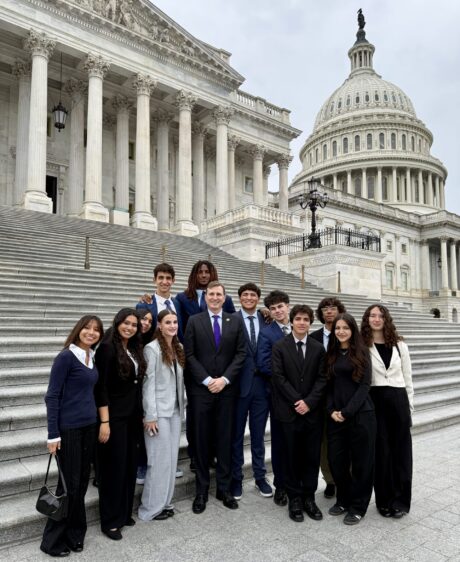
The JLTC program, now in its 21st year, is coordinated by Jewish Philanthropies of Southern Arizona. The unique program brings together Jewish and Latino high school students from across Southern Arizona for months of cultural exchange and leadership training, culminating in a lobbying trip to Washington, D.C.
Last month, the teens and their adult chaperones, Brad Goldstein, Shari Gootter, Lisa Kondrat, and Matt Landau, visited D.C., where the students promoted two bills related to gun violence prevention.
The group chose two subtopics, background checks and safe storage, Chacon explains. One of their aims, particularly with the safe storage bill (S.926 – Saving Our Veterans Lives Act of 2025), was to limit access by children and teens to help prevent accidental deaths and suicides as well as school shootings.
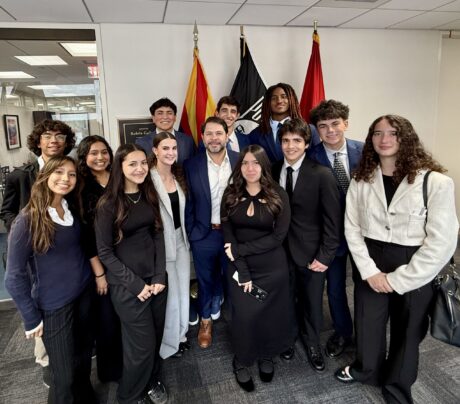
The JLTC participants met with Arizona Sens. Mark Kelly and Ruben Gallego and Rep. Adelita Grijalva, whose father, the late Raúl Grijalva, helped start JLTC.
Along with the Arizona lawmakers, the group’s jam-packed schedule included meetings with Sen. Cory Booker of New Jersey, Rep. Dan Goldman of New York, and Rep. Chuy Garcia of Illinois, plus staff members from the offices of five other legislators.
On Capitol Hill, one of the students shared a personal story of a near-miss gun incident in the home that might have been prevented by safe gun storage.
The bill JLTC supported, S.926 – Saving Our Veterans Lives Act of 2025, and a related House version, H.R. 1987, “requires the Department of Veterans Affairs to implement a program to provide, upon request, a firearm lockbox (or voucher for such item) to eligible individuals.
Currently, Mandel notes, if you are a veteran and wish to receive a free lock box, “you need to prove that you are predisposed to have a suicidal episode or some moment where you’re not safe to the people around you or yourself.”
Chacon explains that the bill’s passage would open the door for more gun safety in civilian cases.
Another JLTC participant spoke about a family member, a veteran who chose not to have a firearm after he left the armed forces due to struggles with post-traumatic stress, says Shari Gootter, who has led the JLTC as a volunteer since 2006
The second bill the JLTC teens supported was H.R.18 – Bipartisan Background Checks Act of 2025, which establishes new background check requirements for firearm transfers between private parties (i.e., unlicensed individuals).
Specifically, it prohibits a firearm transfer between private parties unless a licensed gun dealer, manufacturer, or importer first takes possession of the firearm to conduct a background check.
In addition to the scheduled meetings on Capitol Hill, the group had a chance meeting with Texas Rep. Al Green when Mandel spotted him getting coffee at the D.C. airport.
“He let us have his time for five minutes,” Mandel says, explaining that Green called his policy advisor to check whether he was co-sponsoring the bills JLTC was lobbying for.
“I think we gained some good traction with him,” Mandel says, adding that none of the legislators they met were against the bills. “It was more of an informational run … once they heard what the bills were about, they said they’d get on it.”
Brad Goldstein, an attorney who first volunteered with JLTC 16 years ago, was impressed that Mandel recognized Rep. Green.
But this year’s entire cohort was impressive, says Goldstein, who helped JLTC groups practice their pitches while he was in law school in D.C. After returning to Tucson in 2023, he jumped back in as a mentor and chaperone.
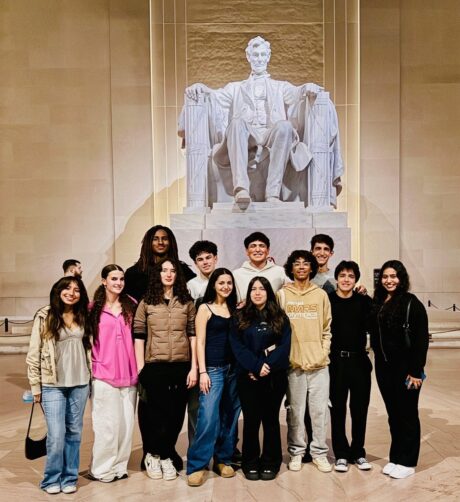
“This group, I think, bonded particularly quickly,” Goldstein says, explaining that the teens met most Sundays for four months before the D.C. trip. They got to know each other over exchanges of food from their cultures and began discussing topics.
The group did change topics, says Gootter. “It just showed their willingness to work together early on and make this meaningful and topical.”
“It definitely took us a long time to choose a topic. It’s kind of sad,” Mandel says, to realize how many problems the group had to choose from.
This year’s trip coincided with National Youth Violence Prevention Week, and the teens took part in a press conference from a group called 30 Under 30, honoring the lives of young people who had been killed by gun violence. Several elected officials spoke, along with the mothers of some of the victims.
“It was heartbreaking and inspiring,” Gootter says.
Other items on this year’s JLTC itinerary included meetings at GIFFORDS, the gun violence prevention and advocacy group led by former Rep. Gabrielle Giffords, who survived being shot at a constituent event in Tucson on Jan. 8, 2011; the Schusterman Family Foundation; MAZON: A Jewish Response to Hunger; Meals on Wheels America, where they met with former Tucsonan Josh Protas, now the organization’s chief advocacy & policy officer; and Jewish Federations of North America.
At JFNA’s new office in Washington, “we had an amazing panel,” Gootter says, explaining that the director brought in seven or eight people who spoke about their various portfolios.
“The kids really got a sense of the work and the many different facets to it,” she says.
They also met with Aaron Jenkins, who previously ran Operation Understanding, a program that brought together Black and Jewish teens.
“It no longer exists, but he still meets with us, and he talks about his experience as a participant, and then also as a professional, and how it shaped him and his life. So those kinds of meetings are really special, and they kind of prepare the students for what’s to come,” she says, noting that Jenkins now works for the D.C. attorney general.
For Mandel, who learned about JLTC from friends who are past participants, touring Capitol Hill and visiting the House and Senate galleries was a dream come true. He explains that his parents always had “something political” on the TV.
The week in Washington was “really incredible,” he says, but he enjoyed the whole program, especially being “around the table with a bunch of people who are really into politics and who want to learn more.”
Chacon was already a student leader, active in the National Honor Society — it’s why her AP History teacher recommended she apply for the JLTC. But the program “100% made me more confident in engaging other people and getting them to work together,” she says, adding that she recently raised money and awareness for Luv Michael, a program that supports adults on the autism spectrum.
She says that “students can make a major impact” is one of her main takeaways from JLTC, along with “a person’s voice matters immensely.”