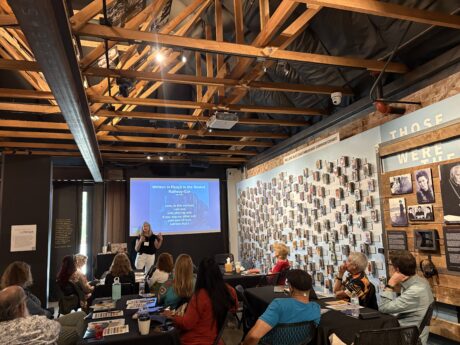
The way a teacher introduces the Holocaust can stay with students long after the unit ends, shaping how they understand prejudice and hatred for years to come. That responsibility, and the skill it takes to carry it into a classroom, brought educators, TJMHC board members, docents, and staff to Tucson Jewish Museum & Holocaust Center for TJMHC’s annual Educators’ Conference this week.
Arizona law requires public schools to teach students about the Holocaust or other genocides on at least two separate occasions between seventh and twelfth grade, but leaves the “how” up to individual schools and teachers. Conferences like this one give educators the training and resources to meet that requirement well. This year’s conference was held in partnership with the Arizona Department of Education and Echoes & Reflections, a national organization that has provided free, standards-based Holocaust education resources and training to teachers since 2005.
Sessions covered Arizona’s state standards for teaching the Holocaust, approaches to teaching the Holocaust through the humanities, propaganda analysis, and media literacy. Longtime Arizona educator and 2021 TJMHC Educator of the Year, Kim Klett, headlined the conference. Klett taught English at Dobson High for 31 years, where she developed a Holocaust literature course that grew from a single semester to a full year of study and helped shape TJMHC’s first in-house Holocaust curriculum. Sharon Glassberg, Coordinator of Holocaust Services & Jewish Inclusion at Jewish Family & Children’s Services of Southern Arizona, held an Intro to Judaism session, giving educators a grounding in Jewish practice and identity to carry into their classrooms alongside the Holocaust curriculum.
One seventh-grade teacher in attendance reflected on her experience. “I love lesson planning, but with such a sensitive topic, I want to ensure my resources are sound and from reputable sources. The resource library provided by Echoes & Reflections is astounding. The conference was thorough and gave more information and resources than I could ever hope to use! It’s incredible that this is free,” said Jacqueline McKnight, who teaches English at Basis North.
TJMHC sees this conference as part of its role as a hub for teachers and educators to gather, learn, and share what works. “I am personally excited about the potential for future educational opportunities,” said Lynn Davis, TJMHC’s Interim Executive Director. “This conference broadened our base of resources and knowledge, and helped us expand the stories that we tell.”
Holocaust education is not only about remembering the past. It gives students the language and context to recognize prejudice, propaganda, and dehumanization in their own time, and to choose how to stand against them. Equipping teachers with the resources to teach confidently about the Holocaust is one of the most direct ways TJMHC carries out its mission.