
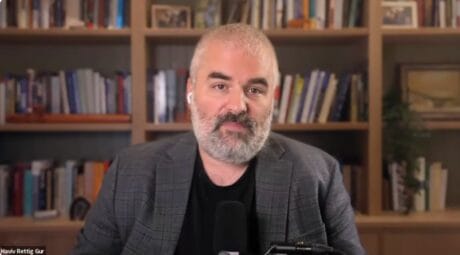
Haviv Rettig Gur doesn’t deal in soundbites.
Fans of his popular podcast, Ask Haviv Anything, know that the Israeli analyst offers answers that are thoughtful, rooted in history — and often unexpected.
Haviv will bring his podcast format live to Tucson on Sunday, Jan. 31 as part of the Jewish Philanthropies of Southern Arizona 80th Anniversary Celebration.
In a phone interview with the AJP this week, Haviv shared thoughts on the U.S.-Israel relationship in the wake of elections in both countries. He expects the political rhetoric between the countries to change as new leaders take office in the U.S. — and possibly in Israel — while strategic and military ties remain durable because both countries have ongoing security interests.
“If the relationship deteriorates to the point where America is not a reliable supplier of parts to make strategic weapon systems that Israel purchased, like the F-35, then everybody America has sold F-35s to has to notice that,” he says. “America doesn’t want to make that statement to the world, and so even a progressive administration that’s deeply, deeply skeptical about Israel is still not going to want to hurt something as significant to America as the reliability of its strategic systems in the world.”
Israel “will stand its ground against its enemies,” he adds. “Iran is not going to be less the brutal revolutionary regime that they’ve been for 48 years because America’s political class no longer sees Israel as a special relationship.”
The U.S.-Israel relationship isn’t as old as people think, he notes. In 1948, when the Arab countries invaded, “America placed an arms embargo on that fledgling, desperate Israel,” he said, and it wasn’t until the 1970s, “when Israel turns out to be strong and stable and useful, and the Arab world is deeply in the pockets of the Soviets,” that the allyship really developed.
He stresses that when Iran is asked by Al-Jazeera or other news sources why it cannot win against “a few million Jews,” Iran always answers that the Jews of Israel are “actually a long arm of the American empire. And so it’s okay that we keep losing. It’s not our dysfunction. It’s not our weakness. It’s not our tyrannies that have decimated our own economies and destroyed the education of our people.”
For Israel, the silver lining of a less warm U.S.-Israel relationship, he says, would be “that it takes that excuse away from our enemies.”
American Jews and Israeli Jews often misunderstand each other because their histories are so different, Haviv says.
The bulk of American Jews arrived between 1880 and 1921, a period that saw millions of Jews fleeing persecution and violence, including well over 1,000 pogroms and as many as a quarter of a million Jews murdered in Eastern Europe. But most American Jews have forgotten that history, Haviv says, because “American Jews have had a history of unbelievable, astonishing acceptance and integration at a scale that no Jews had ever experienced in the history of Jews.”
“There was no moment in Russian Jewish history, or Iraqi Jewish history, or Yemeni Jewish history, or Polish Jewish history, or German Jewish history, where the Jews could just be the people of the land,” the way that American Jews have been accepted as Americans, he says.
Conversely, the Jews of Israel “were the refugees when liberalism died in the Russian empire” with the 1881 assassination of Emperor Alexander II, he says.
In Iraq, “there was a Jewish community that was 1,000 years older than Islam in Baghdad, and they were gone in 20 years,” amid a purge of many minorities. The Jews were unable to survive in any of the Arab countries in the post-imperial era, he says, and they fled to Israel, with some also going to France.
“So who are the Jews of Israel? They are the last living Jews of the Eastern Hemisphere, basically,” Haviv says, explaining that the only people who predicted the collapse of liberalism were Herzl and other Zionist leaders in Europe.
When you have such a radical divide in historical experience, he says, it affects your assumptions about everything.
“Israelis have a long history that teaches them that American Jews’ liberalism is a dangerously optimistic way to navigate a sometimes brutal world, and American Jews have a long history that teaches them that the liberal promise can actually succeed, and that when it does, it becomes the best guarantor of safety and equality and freedom anyone’s ever found. These opposite conclusions flow from opposite histories and lead to some radically different politics. And they’re both right,” he says.
Haviv will be happy to explain this in greater detail at the JPSA anniversary event, along with his thoughts on confronting antisemitism, keeping American Jews connected to Israel when they disagree with its government, and much more.
The event will also include the honoring of JPSA’s Man and Woman of the Year, Paul Patterson and Karen Faitelson, and Young Man and Young Woman of the Year, Kameron Norwood and Kathy Gerst.
Registration is available here.