
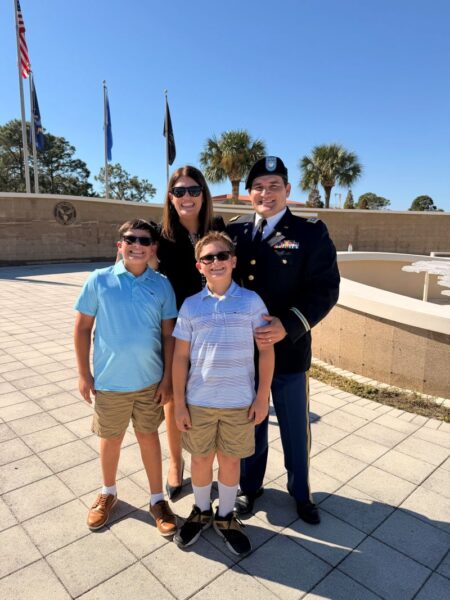
Lt. Col. Isaac Greenberg retired from the U.S. Army on Nov. 11, Veterans Day, after 21 years of service — 25 if you count his time as a cadet at West Point.
An Army reservist for the past 11 years, Greenberg, who turns 44 this week, is hanging up his boots to focus more on his children, now 9 and 11, and his career.
“I’ve got to seize the moment,” he says, explaining that the deaths of two of his siblings, Anna and Tzadik (Zachary), along with 19 of his West Point classmates, make him all too aware that time is limited.
Greenberg, who grew up in Tucson, entered West Point on July 2, 2021, aiming to become an FBI agent.
But just 10 weeks later, the September 11 terror attacks took place.
“That changed the trajectory of my generation and certainly changed mine,” he says.
“I graduated in 2005, commissioned into military intelligence, deployed to Afghanistan twice, commanded soldiers, served around the Middle East, transitioned to the Army Reserve, and eventually spent the last several years at U.S. Central Command,” he says.
His primary job for the past nine years has been at Lockheed Martin, a major aerospace and defense contractor, a position that allows him to continue supporting the military.
From the start, Greenberg’s Jewish identity was a cornerstone of his Army career.
He recalls being in Cadet Basic Training when a sergeant yelled, “I need all the Jews! If you’re Jewish, come with me!”
“We got loaded into an Army truck and taken to the Jewish chapel for Shabbat. That chapel became a sanctuary for me,” he says, giving him a connection to home, to Judaism, and to other Jewish cadets.
Rabbi Carlos Huerta, the Jewish chaplain, helped him understand that he didn’t have to hide being Jewish to succeed in the Army. “His example ultimately influenced how I served. I wanted to be the person who could help another Jewish soldier feel that they belonged.”
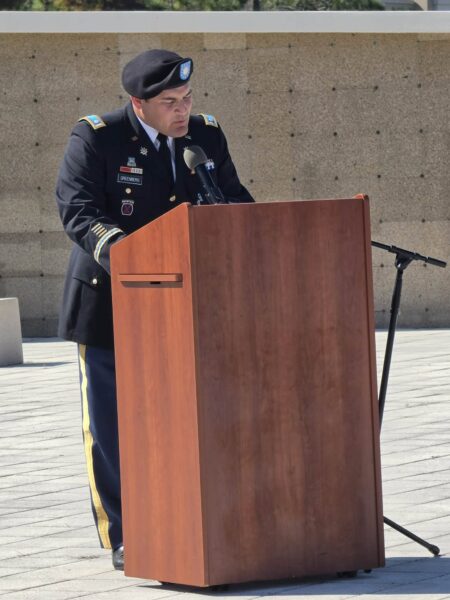
Judaism helped keep Greenberg grounded amid the danger of his deployments in Afghanistan.
He became a Jewish lay leader, holding Shabbat services when he could – even when he had a congregation of just one other soldier.
His mother, Alayne Greenberg, would send him care packages for the holidays.
During his first deployment to Afghanistan, his commander, Lt. Col. Christopher Cavoli, asked Greenberg to teach him how to play dreidel. Cavoli later became a four-star general and Supreme Allied Commander Europe.
Greenberg raised an American flag in Afghanistan in honor of 9/11; he later donated the flag to Tucson Hebrew Academy.
During his second deployment, Greenberg led Shabbat, Hanukkah, Passover, Rosh Hashanah, and Yom Kippur services. “Sometimes there were only a handful of Jewish soldiers. But that’s what was so meaningful. Judaism became a way of creating normalcy in an abnormal environment,” he says.
During that tour, he helped oversee Jordanian soldiers in Afghanistan.
“We wanted to bring some kind of Muslim and Arab presence to Afghanistan to show the people that we’re not just bringing in our Western values; that we are bringing in moral values of peace, prosperity, and trying to help them rebuild their nation,” he says.
On one occasion, he overheard the Jordanians referring to him as a Jew in Arabic.
“I said, just joking around, ‘You guys talking about me? I heard you say Yehudi,’ and they said yes. And so we chuckled, and then we had some coffee, and said, you know, one team. We’re all from the same background. We’re just here to get rid of the Taliban.”
Greenberg met his wife, Felicia, while stationed at Fort McPherson in Atlanta, Georgia, and credits her with providing the support he needed to continue his military career.
“And my two boys, Noah and Asher, have grown up watching their dad put on the uniform. My sister Anna also had a profound impact on me. She passed away from cancer while I was serving in Hawaii. Her attitude toward life — what we called her ‘Annatude’ — reminded me to focus on the things that really matter. Eventually, my priorities became very clear: serve honorably, take care of my soldiers, and come home to my family.”
Greenberg believes it is important for young Jewish Americans to know they can serve in the military. He is a lifetime member of Jewish War Veterans and more recently has worked with the Aleph Institute, speaking at synagogues and Hebrew schools about his experiences.
“Jewish Americans are Americans, and we should be represented throughout every part of American society,” he says. “But representation isn’t just about numbers. It’s also about being able to bring your experiences, your values, and your perspective into the organization. I’ve served alongside people from virtually every background imaginable. That’s one of the great strengths of the American military. I want young Jewish Americans to know that they can serve too. They don’t have to choose between their Jewish identity and their American identity.”

Greenberg really came into his own when he took on leadership roles, says lifelong friend Adam Kwasman, who now lives in Scottsdale.
“Isaac was always the kind of guy who, when he could lead others, he himself becomes the best version of himself,” says Kwasman, adding that he’s met several of the soldiers who credit Greenberg “not only with getting them through their military careers, but also their personal lives alongside it.”
Greenberg and Kwasman met as two-year-olds in Congregation Anshei Israel’s preschool. They attended Tucson Hebrew Academy together from kindergarten through eighth grade and have stayed close despite Greenberg’s deployments and his move to the East Coast, serving as best man at each other’s weddings.
For Kwasman, Greenberg’s fidelity to Judaism throughout his career is akin to “grabbing the torch of the Jewish soldiers who fought in World War II, like his grandfather and my grandfather, who were proud of their Judaism and fought with the American flag.”
Retirement is bittersweet for Greenberg, who says he will miss the people most.
“The Army brings together people from completely different backgrounds, religions, races, and parts of the country and gives them a common mission. I’ve served with incredible people in some very difficult places,” he says.
“I’ll also miss the sense of purpose. There’s something special about putting on the uniform and knowing you’re part of something bigger than yourself.”
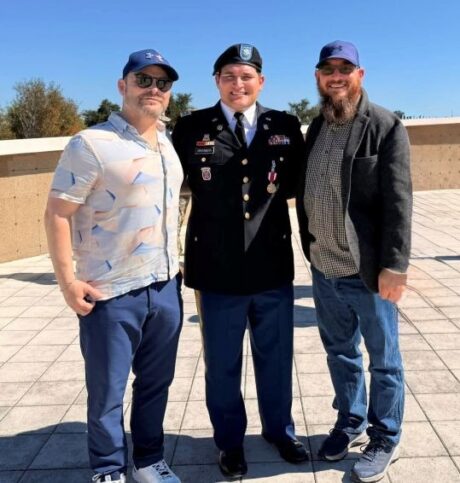
Greenberg celebrated in Tampa with family and friends, including his brothers Aaron and Benjamin. His parents were unable to travel from Tucson due to his mother’s recent surgery but were able to watch his Nov. 8 retirement ceremony virtually.
“Too many times in the past 13 years we have come together for my sibling’s funerals and memorials for Anna and Tzadik,” he says. “This time the family can celebrate; they all played a role in my career and influenced my decisions as a Jewish American soldier.”