
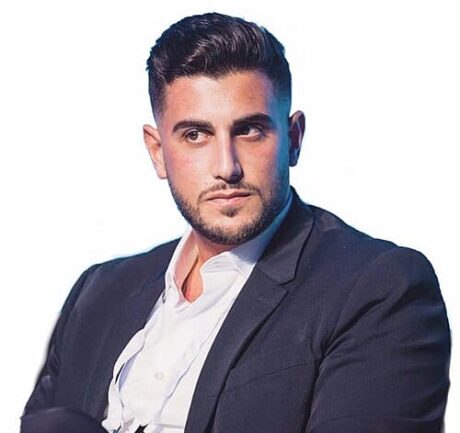
Rudy Rochman was seven years old when his mother was kicked off a London tour bus because she was wearing a T-shirt with Hebrew writing on it.
It was a defining moment, but the story doesn’t start there, says Rochman, 33, who will be the guest speaker at Jewish Philanthropies of Southern Arizona’s Men’s Night Out on Thursday, Nov. 12.
At seven, Rochman explains, he already knew his grandparents came from four different countries – Morocco, Algeria, Poland, and Belgium – where each had been persecuted for being Jewish. It made him realize that being Jewish was the core of his identity, more than where he was born (France) or raised (France, Israel, the U.S., and more).
When the London bus driver said, “I don’t want any Jews on my bus” and grabbed his mother by the arm, Rochman wanted to respond, but he didn’t have the tools.
“No one taught me how to respond to this verbally, intellectually, deal with this emotionally, respond physically to defend my mom,” he says. “I told myself, the next time I would see any form of injustice against my family, against my people, I’d have to be ready.”
Reflecting on the incident also made him realize that Judaism is more than a religion. “It’s a suitcase” that we packed to preserve our identity when we were forced into exile, he believes.
At 17, Rochman enlisted in the Israel Defense Forces as a paratrooper, and after the army, chose to pursue his bachelor’s degree at Columbia University because it was listed as the most antisemitic school in North America.
“If we don’t go to those places, who’s going to go live for us?” says Rochman, who started a pro-Israel movement on campus. “I don’t want to hear about black rights from KKK members. I don’t want to hear about women’s rights from misogynists. So why are the only people talking about the Jewish people in Israel those that are anti-Jewish and anti-Israel?”
Now a social media influencer with more than 600,00 followers, Rochman travels to college campuses and Jewish community events around the world to share his message of Jewish strength and unity.
Tucsonan Ben Pozez has followed Rochman for a while and heard him speak in Tel Aviv in June.
“I think that he has a lot of unique and different ideas in terms of how to create a lasting peace in Israel,” says Pozez, who recommended him for Men’s Night Out.
It starts with gathering in the “lost” tribes of Israel, says Rochman, who has created a documentary series, “We Were Never Lost,” about Jewish communities in Africa.
Rochman was shocked when he overhead a former Columbia student tell a Chabad rabbi about her visits with Jewish communities in Tanzania and Uganda. He had no idea there were African Jews beyond North Africa and Ethiopia.
“Imagine as a 24-year-old, you find out you had a brother or sister your whole life you never knew about,” Rochman says.
His shock turned to frustration when he realized many of those African Jewish communities were suffering, subject to the same antisemitic tropes about controlling the banks and the media as Jews in the U.S. or Israel.
Pointing out that the Ashkenazi, Sephardi, and Mizrahi Jews that make up modern Israel account for only about 2.5 of the biblical 12 tribes of Israel, Rochman says that if Israel would accept the approximately 20 to 50 million African Jews who long to make aliyah — including many Ethiopian Jews who were not included in Operation Solomon — there would be no demographic issue in sharing the land with the Palestinians.
Such aliyah could also alleviate Israel’s “brain drain,” he says, noting that the Igbo in Nigeria are the richest and most educated demographic in Africa.
As for generations of hatred between Israelis and Palestinians, Rochman believes relationships can change if conditions change, pointing to China and Japan, the British and the Vikings, and post-Holocaust Germany supporting the State of Israel as examples.
Acknowledging the divide between the left and the right in Israel, he asks, “The left, what do they talk about? Human rights, minority rights, animal rights, pollution. All those things are true and important. And the right, what do they talk about? Security, economy, national identity … We need to bring in all these different elements of what’s important and what’s true together, rather than using them to pull us apart.”
Rochman doesn’t claim to have all the answers.
“I hope that my answers only serve as a way for other people to say, ‘Well, I also have something to say,'” he says.
Although Rochman seeks to promote peace, when Israel needs defense, he’s there. On Oct. 7, his reserve unit was sent to Kfar Aza, one of the kibbutzim that bore the brunt of the Hamas attack.
Describing the devastating scenes they witnessed, he says, “We did everything we can to save as many people’s lives” as they could.
His unit was also the first to enter Khan Younis in Gaza, “then first ones into Lebanon, and about a month and a half ago I got out my third tour in Lebanon,” he says.
The war is the result of not stopping Hamas and freeing the Palestinians in Gaza long before Oct. 7, he says, explaining that he left Gaza “with three suitcases filled with Hamas propaganda that teaches the kids of how to hate Jews. That wasn’t something new. That’s something we all knew.”
Saying “never again,” he believes, “is a commitment to make sure you’re now living your life to make sure it doesn’t happen again, which I hope that this time we learned.”
Pozez says he’s looking forward to hearing more of Rochman’s outside-the-box ideas about coexistence at Men’s Night Out, with Rochman “maybe challenging some people’s ideas and preconceived notions and giving people lots to think about.”
Men’s Night Out will also include the presentation of the MENsch of the Year Award to Keith Dveirin, M.D. A recently retired pediatrician and mohel, Dveirin has been instrumental in starting and running JPSA’s Jewish Healthcare Network and Maimonides Society. He has been engaged with JPSA for many years in various roles, including as a Young Men’s Group alum. He led the volunteer medical group for the JCC Maccabi Games and is involved in the Tucson Jewish Museum and Holocaust Center as a second-generation Holocaust survivor.
Men’s Night Out is open to donors who have pledged donate at least $180 to the JPSA 2026 Annual Campaign. Tickets are $80 and include dinner. To register, click here.