
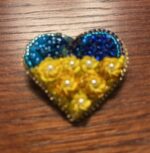
Over the last four years, I have donated money to help the courageous people of Ukraine cope with the effects of the invasion and war perpetrated on their country by Russian President Vladimir Putin. At times, I have also bought craft items I found on Etsy, created by men and women living in the midst of the war zone. The latter activity enabled me to send personal messages of hope and encouragement along with my order.
Since the invasion, I have also become a fan of Ukrainian president Volodymyr Zelenskyy. I am proud that he is Jewish, and I believe he has shown great courage, leadership, and strength of character in these difficult times.
As I donate, order, and cheer for Ukraine, I also find it somewhat ironic in light of Jewish persecution in Ukraine over many centuries.
First and foremost, my own father and his family left Ukraine in the early 20th century because of it. Yes, the country at that time was part of greater Russia, but the history of the Jews in Ukraine is one of pogroms and persecution.
This raises a question: Is it all right to cheer for a country and nation with a history full of the blood of my people? I seem to remember that there are many instances of revenge killings by the Israelites and G-d himself against the enemies of Israel in the Bible.
Two years ago, my synagogue in Tucson was planning a retreat focusing on “Jewish Resilience in a Changing World.” To highlight this theme, we devoted two sessions to periods in Jewish history when Jews faced extreme persecution and took extraordinary steps to meet the challenges of their times. For one session, we chose the Spanish Inquisition and the year 1492, when the Jews were expelled from Spain. For the second session, we selected the Soviet Jewry Movement in the latter part of the 20th century, when Jews faced extreme discrimination but were forbidden to leave Russia for Israel.
Coincidently, my professional life in the ’80s was spent directing communications departments for major Jewish organizations. One of my responsibilities was to oversee the creation of marketing pieces to publicize the situation in Russia and galvanize the Jewish community to support efforts promoting Jewish emigration. It was for this reason that I agreed to present the session on Soviet Jewry.
At that point my professional responsibilities and my personal history converged.
As noted above, my father and his family were born in Ukraine and, like many millions of other Jews, they left the country to be free from pogroms and discriminatory laws that resulted in poverty and deprivation. As a result, it was exhilarating to focus so much of my energy on this issue and to be part of a Jewish national movement of liberation.
In preparing my presentation for the synagogue retreat, I decided to go back in history two or three hundred years to gain a deeper perspective of the origins of Jewish history in Soviet territory and what might have influenced the courage and resilience we were celebrating. The research yielded a trove of information on Ukraine. What I learned was not so positive.
Some facts:
- Before Hitler, there was Bogdan Chmielnicki, a Cossack and peasant, who led an uprising against Polish rule of the Ukraine in the 17th century. Jews had settled in Poland about 1000 CE, invited by Polish noblemen who wanted them to administer their estates and serve as tax collectors. This latter role inspired hatred among the peasants and townspeople throughout Poland and its territories, including Ukraine. Chmielnicki, who even today is viewed as a national hero in Ukraine, sits astride a horse on a bronze statue in Kyiv that commemorates his valor and nationalism. What it does not mention, however, is how he used his support and popularity to massacre the Jews in all the lands where he fought. He is said to be responsible for leveling some 300 Jewish villages and murdering over 200,000 Jews in the process.
- In the 18th and 19th centuries, some of the most violent pogroms took place on Ukraine soil, abetted by Jew hatred espoused by the church and local population, including the 1768 massacre in Uman, final home and burial place of Rabbi Nachman of Breslov, considered one the greatest Chassidic rabbis of all time.
- Babi Yar: One of the most infamous Nazi killing grounds of World War II, located near Kyiv, Ukraine, where approximately 34,000 Jewish men, women, and children were murdered over two days in September 1941. The Nazis received help there and throughout the country in their murderous rampage by many local authorities and anti-Semites.
So, here I am so many years later cheering and helping Ukraine, the little guy against the Evil Empire.
Somehow I have managed to compartmentalize the history and the here and now, the horrors of the past and the importance of supporting this country fighting for its life. On some level, it seems the Jewish thing to do.
Judith Manelis is a Tucson-based writer, editor, and journalist whose work has appeared in American Jewish newspapers and magazines. Her book “This Shall Tell All Ages: Art, Music and Writings of the Holocaust” was published by United Jewish Appeal.