This article is part of a series around Jewish early childhood education at the Tucson J.
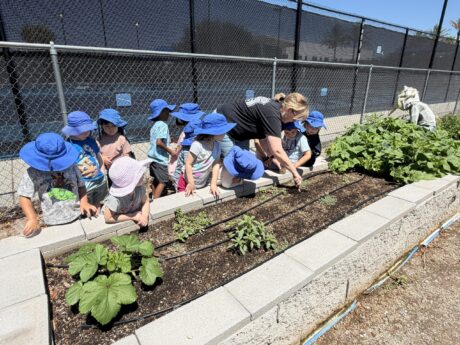
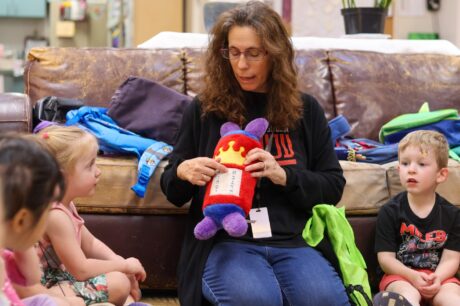
Throughout each day, babies, toddlers, and preschoolers in the Tucson Jewish Community Center’s Early Childhood Education program discover the world around them through play, curiosity, and connection — studying a painting in the fine art gallery, dressing up for a Purim parade, or finding the mitzvah in a beloved storybook. On Friday mornings, the J comes alive with the sound of children singing Shabbat songs. At snack time they enjoy fresh challah and on Mondays, those same voices gather again for Havdalah, the ceremony to mark the end of Shabbat (traditionally held on Saturday evenings), welcoming a new week with music, ritual, and community.
These experiences may appear effortless, but they are intentionally designed. The Tucson J’s Early Childhood Education program is guided by the Sheva Early Learning Framework, developed by JCC Association of North America, which outlines a dynamic vision of excellence in Jewish early childhood education grounded in research and multiple philosophies of early education.
“Sheva” means “seven” in Hebrew. The framework is rooted in seven Sheva lenses that reflect core Jewish values and animated by core elements that guide how those values come to life each day. Together, they provide a common language for lesson planning, classroom environments, professional development, and family engagement. While grounded in Jewish wisdom, these values resonate with families of every background and help all children cultivate curiosity, compassion, confidence, and a lifelong love of learning.
Hit’o’rerut – Awakening
Our lives are enriched by a sense of amazement.
Children are natural constructivist learners, and wonder is often where learning begins. The Tucson J’s classrooms, art studio, playgrounds and indoor play space are designed to inspire inquiry, and children can also explore the fine art gallery, sculpture garden, and gymnasium. A group of toddlers may become fascinated by shadows stretching across the playground, while preschoolers build the Western Wall from blocks before carefully sticking on a note. As children move through the building they are often singing as they go — sometimes in Spanish, other times “The Itsy Bitsy Spider” with akavish, the Hebrew word for spider, woven into the lyrics.
Brit – Covenant
Commitment to self, family, friends, and the world is the foundation for responsibility and compassion toward others.
The Sheva framework recognizes families as engaged partners in their children’s learning. At the Tucson J, relationships are just as important as routines. The J’s Open Space was created as a place where families can pause and play with one another before or after the school day. Families connect and make memories together at Shabbat family picnics, pool play dates, and classroom experiences such as making matzah for Passover. Through daily conversations, volunteer opportunities, the Brightwheel communication app, the monthly Buggy Bulletin, and classroom documentation, the J invites families into the learning process, recognizing that children thrive when home and school are connected.
T’zelem Elohim – Divine Image
At each person’s core is an undeniable spark of dignity that requires nourishment and encouragement.
Every child deserves to be seen as capable, competent, and full of potential. That belief shapes how the J’s educators approach each day. Rather than focusing only on outcomes, teachers encourage children to ask questions, solve problems together, make choices, and build confidence through play. Educators are also recognized as professionals whose growth matters. Through monthly Sheva-centered professional development and collaborative reflection, teachers continue refining the ways they support every child and family.
Kedusha – Holiness
We strive to bring our full presence to everything we do in order to recognize the unique, miraculous nature of every moment.
Some of the most meaningful learning happens during everyday rituals and routines. Observing wildlife in the windows of the J’s main hallway, singing the motzi before snack time, lighting Shabbat candles, or listening to a story all invite children to slow down and be present. These moments help create a rhythm to the week and remind children that even ordinary experiences can become opportunities for gratitude, connection, and joy.
D’rash – Interpretation
A spirit of inquiry is the impetus for growth and reflection.
Inquiry isn’t just for children — it guides the J’s educators as well. Every week, teachers intentionally incorporate one of the Sheva lenses into their lesson planning, ensuring that Jewish values are woven naturally into classroom experiences. Monthly professional development invites teachers to examine classroom scenarios through different Sheva lenses, read current research, learn from one another, and set personal goals for strengthening their relationships with children and families. Just as they encourage children to remain curious, they ask the same of themselves.
Masa – Journey
Telling and retelling stories from our past helps us renew our strength and refine our vision for the future.
Stories connect children to something larger than themselves. Through weekly Shabbat and Havdalah gatherings, Jewish holidays, and bi-monthly classroom visits from the J’s Jewish Culture and Curriculum Coordinator, children experience Jewish traditions as living, joyful experiences. Families are invited to celebrate holidays at the ECE Purim and Passover parades, volunteer to make latkes and matzah, and view their children’s art in the sukkah. Local rabbis and cantors regularly join the J’s classrooms, and books, music, and celebrations help children see themselves as part of an ongoing story and develop a strong sense of Jewish peoplehood.
Tikkun Olam – Repair of the World
We must live for the benefit of others, both in this generation and for the generations to come.
One recent installation in the ECE Open Space invited children to think about caring for beaches and oceans. They built with sand, explored books about Tel Aviv’s coastline, discussed the animals that live in the water, and talked about simple ways people can help protect our environment. In the classroom, favorite picture books become opportunities to discover kindness, generosity, and responsibility. Through movement, healthy habits, and caring for one another, children also learn Sh’mirat HaGuf — taking care of our bodies — as an important part of caring for the world around us. These experiences help even the youngest learners understand that repairing the world begins with everyday actions.
The beauty of the Sheva Early Learning Framework is that it isn’t something children experience only during a lesson or a holiday celebration. It is woven into the rhythm of each day — creating an environment where children are valued and nourished, educators are continually learning, families are partners, and Jewish values are lived rather than simply taught.