
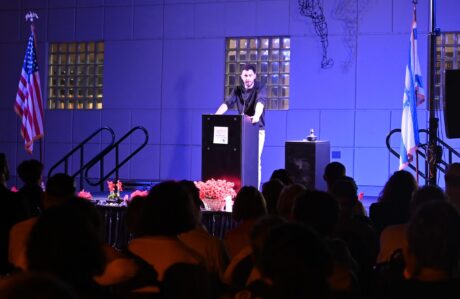
The third anniversary of the Oct. 7 Hamas attacks on Israel is a memorial for those murdered and taken hostage, but it is also much more, Hava Leipzig Holzhauer, president and CEO of Jewish Philanthropies of Southern Arizona, said at the start of “Kindling Hope,” the community’s commemorative event hosted by the Weintraub Israel Center, a program of Jewish Philanthropies of Southern Arizona and the Tucson Jewish Community Center, held Wednesday evening.
The days since Oct. 7, 2023, have also become “about a Jewish awakening, a forceful break out of our sheltered cocoons of assimilation and safety” to the knowledge that we must protect our community and push back against antisemitism in many spheres, from education and politics to healthcare and the arts, she said.
Most of all, she said, we must “teach our children, grandchildren, and ourselves about our identity and our people’s history,” resisting the pressure of “misguided thinking, of misinformation” so that we may be proud and stand strong, “exhibiting the age-old resilience now embedded within us. “
After Leipzig Holzhauer acknowledged dignitaries including government officials, law enforcement officers, and clergy in the crowd, she introduced Shay Oren, recently arrived in Tucson as the community’s new senior shaliach (Israeli emissary). Oren spoke of his 10/7 experience, the abrupt shift from honeymooning in Tuscany to joining his air force squadron near the Gaza border. He described his frantic drive south, fielding a call from a friend pinned down by terrorists and not knowing if he should detour to save him or continue his drive as he was trained to do. Ultimately, he called another friend for the rescue mission, and thankfully, both survived.
He also described visiting Kibbutz Kfar Aza and the Nova music festival site four months after the attacks and his chagrin at being unable to save more lives.
Three years can seem like it was yesterday and like it was a lifetime ago, he said, adding, “In the past three years, I’ve gathered, unfortunately, stories for a lifetime. We have to honor those heroes every day, as what they’ve done was yesterday. So we can grow together tomorrow.”
Following prayers led by Rabbis Yehuda Palgon, Samuel Cohon, Stephanie Aaron and Sara Metz, Oren and his wife, Amit, took part in a torch lighting ceremony with other community leaders, bringing the flames to the crowd of more than 325 people, who in turn lit battery-operated tapers (see video above, or click here).
The keynote speaker, Uri Sharon, grandson of the late prime minister, spoke of clearing Kibbutz Kfar Aza with his squadron and seeing children’s artwork on the walls. Sharon vowed he’d return to work with those children.
On deployment in Khan Yunis, Sharon used a pocket camera to capture small moments in the everyday lives of soldiers — a card game, a shower crafted from a kettle and a jerry can. Later, working alongside the displaced children of Kfar Aza as he’d promised, he grew to love watercolors, painting the children playing at their improvised school or on his family’s farm, where they could interact with animals.
Every six months he’d return for reserve duty, bringing his camera with him. “Bit by bit, slowly, a kind of testimony was starting to form from two completely opposite universes,” he said.
He displayed his paintings of children alongside his photos in an exhibit in Israel he called “Tom Yaldut,” which means “Innocence of Childhood” in Hebrew, but also can mean “End of Childhood.”
“Putting pictures of war and paintings of little kids, I thought it’s inappropriate,” he said. “But I realized that’s simply our reality.”
Following Sharon, JPSA’s education associate, Molly Dunn, explained her transformation from an undergraduate who vaguely supported the anti-Zionist Jewish Voice for Peace, to a proud Jewish educator and Zionist.
“I believed that when a community was vulnerable, other people had a responsibility to stand beside them. I still believe this, but I never thought that applied to the Jewish people. I thought we were fine,” Dunn said, explaining that 10 years ago she didn’t even know what Zionism meant.
Working on her doctoral dissertation about human trafficking, she said, “I started thinking about the Holocaust through the lens of a people who had been forcibly displaced, exploited for their labor, separated from their families, and murdered. And I realized I had never asked the basic question about the Jews living in Israel: How would they come to be there? Some were Holocaust survivors. Some had been expelled or displaced across the Middle East and North Africa. Others belonged to Jewish communities that had remained in the land for centuries. I had accepted a story in which Jews simply arrived in Israel as Western colonizers. Once I started asking who those Jews were and how they got there, that story stopped making sense to me. I began studying Jewish history, antisemitism, and Israel, and I started asking whether the things I had learned to believe were actually true. By the time October 7th happened, my understanding of Israel and Zionism and antisemitism, and of myself as a Jew, had already changed enormously. And then came October 8. Suddenly, what I had begun to understand about Jews as a people stopped being theoretical.”
She realized that “without Jewish community, I was living in a world where almost everyone except Jews were teaching me who the Jewish people are. Jewish scholarship and Jewish community gave me something I had been missing — a shared reference point from which I could think for myself and understand myself. Three years after October 7, I know this isn’t just about me.”
Citing her work with JPSA’s Center for Jewish Resilience and the newly relaunched Hebrew High, Dunn said that while we can’t control the conversations young Jews might encounter, “what we can do is make sure that our children enter them with confidence in who they are and knowledge of their own history.”
JPSA Board Chair Jeff Artzi ended the evening by referring to the candle lighting ceremony, a reminder that “darkness is not the end of the story. Those lights represent memory, but they also represent hope.”
Just as we have many times before, when the Jewish community faces darkness, he said, “Our response must be to come together like we did tonight.”
As the crowd slowly dispersed, local artist Julie Szerina Stein shared her thoughts on Sharon’s keynote address, calling it a tender demonstration of the power of art to help us express and somehow relieve our sadness.
“It was a very good night,” she said.