
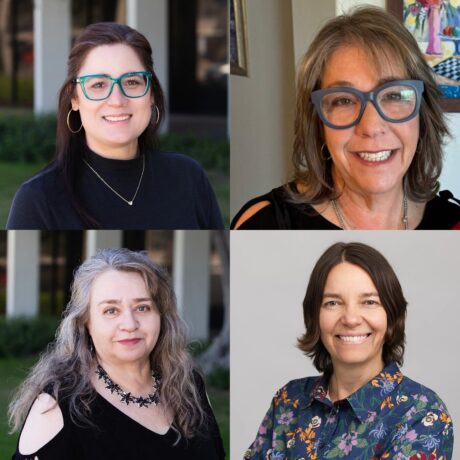
“Trauma-informed care isn’t just for clinicians,” says Sophie German, BSW, CFSW, director of the older adult and community services departments at Jewish Family & Children’s Services of Southern Arizona. These include several financial wellness programs and Jewish holiday programs like Mitzvah Magic.
“Most of the people that we serve in my two departments are not coming to us for mental health treatment. They’re coming because they need help navigating systems, accessing their benefits, and maintaining their independence,” she says.
But “trauma is often hidden,” says Shelley Rood Wernick, associate vice president of Jewish Federations of North America’s Center on Aging, Trauma, and Holocaust Survivor Care and the granddaughter of Holocaust survivors, who spoke at the center’s recent Aging and Trauma Program Showcase. “We have to know that it’s buried, assume that it’s there, and act accordingly.”
JFCS uses a person-centered, trauma-informed (PCTI) approach agency-wide.
There are many ways trauma may happen in people’s lives, including childhood neglect and abuse, a car accident, the loss of a loved one, or through experiences in the military or as a Holocaust survivor, German says.
Key to the trauma-informed approach, she says, is that “we don’t ask people what’s wrong with them; we ask them what their life’s been like. By getting them to share their stories with us, then we’re better able to understand different ways that trauma might be impacting them and causing them to have barriers in their life.”
Some people may need multiple layers of care, with medical and mental health issues on top of traumas they’ve experienced, German says.
“I have some community members that, as a result of their life experiences, struggle to leave their home, and so being able to call us when they are needing a resource or advice or financial assistance gives them a friendly person on the other end who is going to view them as a whole person, not just their experiences,” she says.
From 2018-2020, JFCS held PCTI workshops throughout the community for people caring for older adults. The audience included paid caregivers, baby boomers caring for aging parents, behavioral health and medical providers, home health care agencies, senior service providers, clinical staff and administrators. The workshops were supported in part by a grant from JFNA.
The PCTI approach begins with “unconditional positive regard,” says Sharon Glassberg, MCC, LAC, coordinator of Holocaust survivor services and Jewish inclusion at JFCS. “We’re not judgmental as we convey our feelings of understanding, trust, and confidence. So we encourage clients to make their own decisions and choices.”
Glassberg and Raisa Moroz, JFCS director of Holocaust survivor services, took part in the community PCTI training sessions. The experiences of Holocaust survivors were often used to illustrate how past trauma can affect current behavior, she says.
She cites one survivor who had to stand on bread lines in post-war Hungary and to this day walks out of a grocery store if the lines are long, and another who will not eat salad because during the Holocaust he resorted to eating grass.
Many survivors retain a scarcity mindset, Moroz observes. They will take advantage of free produce distributions or immediately use the grocery gift cards they receive as benefits to buy meat even if they have a fully stocked freezer.
At the community trainings, JFCS provided handouts with tips on communicating with and assisting survivors, plus a list explaining possible triggers, including institutional settings and people in white lab coats.
Sharing that information is “one of the biggest mitzvahs,” she says.
Past traumas can resurface as people age and no longer have the responsibilities of work and raising children to occupy their minds, Glassberg adds.
“It’s important to inform people working with those that are aging that they’re not being combative on purpose, that there’s something underneath the surface that is producing these behaviors,” Glassberg says.
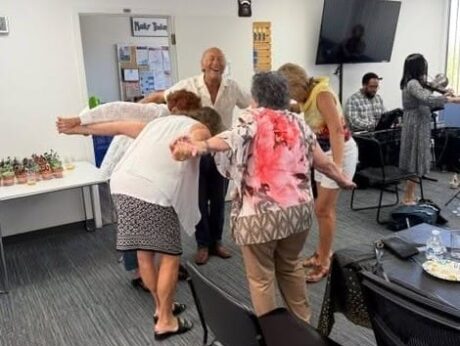
Even at events with a positive focus, such as a celebratory brunch JFCS held last month for Holocaust Survivor Day, it is important not to rush the survivors, because being rushed can stir up feelings of loss of control, she explains.
One way to return control is to give people choices, says Ginger Doran, LCSW, LMT, director of clinical training and workforce development at JFCS.
For Doran, that starts the moment someone enters her office; they are offered a number of seating options, giving them bodily autonomy and a sense of safety. Many also choose the flexibility of telehealth appointments.
Along with clients funded by AHCCCS (Arizona Health Care Cost Containment System — Arizona’s Medicaid program), says Doran, JFCS behavioral health therapists see many clients funded by a Victim of Crimes Act grant.
Starting with the baseline of a person-centered approach, she says, “that person gets to talk about what they feel comfortable with, and it gives them a sense of power and control.”
If someone wants to work on a specific trauma, starting therapy can be “kind of straightforward,” she says, while for other people there is a process of exploration.
JFCS Behavioral Health Services offers various treatment modalities. Some, such as EMDR (Eye Movement Desensitization and Reprocessing), allow a client to focus on smaller portions of the trauma rather than telling the whole story, helping to avoid retraumatization, she says.
Narrative Exposure Therapy, which was developed in Europe and is often used with refugees, “is a cool one,” she says. The client lays out a timeline using flowers, rocks, and sticks to represent different life events.
“It’s accessible across cultures and across language groups. It’s nice to have some neutral, physical things if you’re working through a translator,” she says.
Whatever the modality, allowing the client to have power and control is vital “so that when they’re addressing the trauma, that they, in this environment, do have a choice about even whether we discuss it or not,” she says.
Collaboration is key, German agrees.
“Whenever possible, we’re going to return choice to the individual,” she says.
Whether she’s helping determine what durable medical equipment someone might need to safely age in place, or a clinician is working with someone to create a treatment plan, “we’re not going to tell people what we’re going to do at JFCS. We’re going to ask them what matters most to them.”
For more information visit jfcstucson.org. To learn the stories of Southern Arizonans who survived the Holocaust, explore the following resources: Arizona Public Media’s Children of the Holocaust series; a panel discussion moderated by filmmaker Bret Primak; and To Tell Their Stories, Vols. I and II, edited by Moroz and Richard Fenwick, published by JFCS.