 On June 12-13, Tucson will welcome a unique blend of music, spirituality, and Israeli creativity as the Fuchsberg Jerusalem Center’s Zamru Ensemble arrives for a musicians-in-residence Shabbat. The weekend promises an immersive experience of prayer, learning, and musical connection, rooted in a program that has become a powerful source of comfort and community in Israel during a time of profound challenge.
According to Dr. Stephen Arnoff, CEO of the Fuchsberg Jerusalem Center, Zamru was founded on a vision of harnessing “the energy and creativity of spiritually-minded, creatively-minded leaders and seekers … to enrich the possibilities for prayer and spirituality. Over time, we gathered a core group of musicians focused on bringing innovative ways of using ritual and music and rhythm and words to make meaning. The common denominator is their passion for that way of doing Jewish life, but they come from very, very different backgrounds. We have Zamru participants from the haredi world, the staunchly secular world, and everything in between.” Each gathering is unique, shaped by the moment, the community, and the emotional landscape of participants.
The program took on new urgency after Oct. 7, 2023. As Arnoff explains, weekly song circles began “about a week after Oct. 7 as a way for people to come together during a time of fear and uncertainty.” These Wednesday night gatherings have continued without interruption – even during the war with Iran, when an outdoor concert moved to an underground parking lot during an air-raid siren. The song circle now draws a core community of about 150 people who see it as their spiritual home.
The Tucson weekend, hosted by Congregation Anshei Israel, will bring this spirit of resilience, connection, and beautiful music to Southern Arizona. Events begin Friday, June 12, at 5:45 p.m. with a musical Kabbalat Shabbat service followed by dinner and zemirot (songs).
“We like people to experience the full ensemble until Shabbat formally begins, so that those who are more observant can be comfortable knowing that there will not be musical instruments on Shabbat,” Arnoff says. “The Friday night experience will be unique in its presentation, but will also maintain familiarity… People will feel like their melodies are intact and respected. We’re coming to enhance the experience, not disrupt it.”
As he puts it, for Jewish life to thrive, “you need to have a foundational consistency, as well as a spark of something that’s compelling and inspirational. It’s not one or the other, it’s both.”
At Shabbat morning services, Arnoff will deliver a drash (sermon) on “Songs of Resilience and Hope: How Music Holds Israel Together,” followed by a lunch & learn session exploring “Music, Midrash and Meaning: Bringing text and tradition to life from yesterday to today.” Arnoff says, “I’ll be touching on themes of how we make meaning and community in an October 8th world; the ways that music, community, and spirituality can help lift up all of us, especially at a time when so many feel lonely and isolated because of what’s happening around us.”
The weekend culminates Saturday night with a free concert and Havdalah at 7 pm, featuring the full Zamru Ensemble. Arnoff describes it as a very participatory experience, influenced by the weekly song circles. “While the selection of songs is thematic in certain ways, it is not a traditional ritual. There are some themes that reflect on the times we’re in and reflect on ways of experiencing that together. It feels like a unique space.”
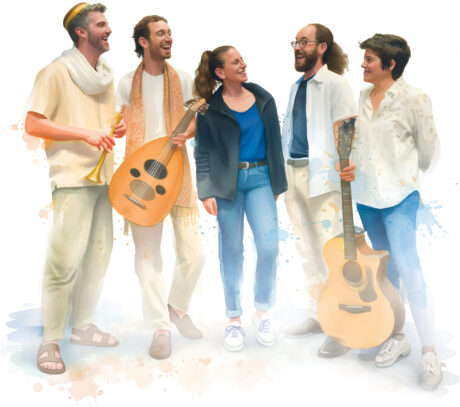
The ensemble’s musicians — each with a rich artistic background — bring a tapestry of global influences. Talia Erdal, principal cellist of the Jerusalem Symphony Orchestra, blends classical mastery with folk and world music. Clarinetist Amitai Mann, with bachelor’s and master’s degrees in performance from the Jerusalem Academy of Music and Dance, draws on Balkan, Mediterranean, and cinematic soundscapes. Multi-instrumentalist Itamar Zakai weaves Eastern and Jewish musical traditions and has performed with leading artists at music festivals in Israel and around the world. Percussionist Yaara Samina, a graduate of the Mizmor School of Music, where she later led the music production department, infuses performances with rhythm, tenderness, and a focus on community. Ensemble leader Dov Wieder, raised in Jerusalem’s ultra-Orthodox community and shaped by travels through Buddhist and Sufi traditions, blends these diverse influences with contemporary Israeli music.
Dr. Arnoff believes programs like Zamru speak to a growing spiritual hunger in Jewish communities everywhere. He notes that innovative musical prayer experiences can help address loneliness and foster belonging — an urgent need in what he calls “an Oct. 8th world.”
Michael Jurkowitz, a student at Pima Community College who recently participated in a retreat with Zamru, says, “The experience Zamru created was very special. It’s a combination of spirituality and amazing music, which brought me to connect to the moment and space around me.”
For Tucson’s Jewish community, the Zamru weekend offers not just a concert series, but a chance to experience the healing, connective power of music.
“Bringing Zamru to Tucson feels especially meaningful at this moment, as their music reflects both the depth of Israeli cultural life and the resilience of a society navigating ongoing challenges,” says Nichole Chorny, Cantorial Soloist and Education and Youth Director at Congregation Anshei Israel. “Their ability to weave Jewish text, tradition, and contemporary expression into a full Shabbat experience, from prayer to learning to a joyful concert, offers our community a powerful and personal connection to Israel through music.”
In addition to the Shabbat programming, Arnoff and Zamru will lead a professional development session for Tucson JCC senior staff on “Holding Complexity: Music, Meaning and the Jewish Public Square.”
“At a time when Israel, Jewish identity, and communal belonging are experienced with heightened complexity — emotionally, politically and culturally — this session offers a space for reflection, listening, and connection across differences,” says Tucson JCC President and CEO Todd Rockoff. “Our team is looking forward to learning with Zamru and having a meaningful discussion. We are grateful to Congregation Anshei Israel for bringing them in and for our partnership in making the opportunity possible.”
Additional co-sponsors for the weekend are the Rabbinical Assembly, USCJ, and Jewish Philanthropies of Southern Arizona.
The musicians-in-residence programs are open to all. Reservations and payment are required for Friday night dinner by June 9. For security purposes, advance registration is required for the free concert on Saturday night by June 11. Details at the CAI website: https://caiaz.org/zamru-musicians-in-residence-june-2026.
For more information about Zamru, follow them on Instagram @zamru.music, listen on Spotify, or check out their website, https://fuchsbergcenter.org/zamru/.