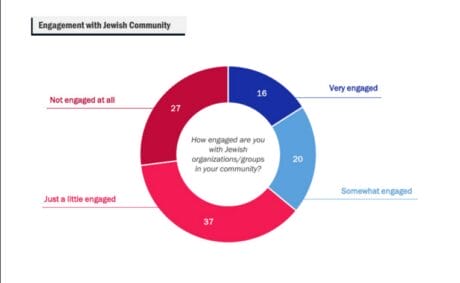
Most Jews in Southern Arizona say their Jewishness is meaningful to them. They have Jewish friends. They know where to find Jewish life if they look for it. Nearly half say they want to be more involved than they currently are.
And only one in three says they feel connected to the local Jewish community.
That is the picture that emerges from a 2025 community “pulse” study Jewish Philanthropies of Southern Arizona presented on April 16 to about 30 professional and lay leaders of Southern Arizona synagogues, agencies and Jewish organizations. The pulse survey provides a portrait of a community that is, in the words of the Guy Edasis, JPSA’s chief marketing and communications officer, “with many who show up occasionally, but have not found their anchor.”
The Pulse survey polled Jewish adults in Southern Arizona between May and July 2025 as part of a 13-community Jewish Federations of North America project examining how Jewish communities are faring across eight measures of communal flourishing: engagement, education, belonging, safety, civic activity, health, caring, and connection to the wider Jewish world.
Edasis presented the local findings to the Jewish Community Ecosystem, a body of organizational leaders that grew out of an earlier community study in 2019-20.
Who Is the Community?
Roughly 25,500 Jews live in Southern Arizona. They are older than their counterparts in other communities surveyed: 49 percent are 65 or older, while just 9 percent are under 35. Sixty percent are married and 31 percent of those have a non-Jewish spouse. About one in five say they are just managing financially or unable to make ends meet.
The denominational picture revealed unexpected insights. Reform respondents lead at 32%. Conservative respondents come in at 18%, with smaller shares of Reconstructionist (4%) and Orthodox (1%) Jews. However, more than half of the community does not locate their Jewish identity in religious denomination at all, with 31 percent describing themselves as “just Jewish” and another 23 percent as culturally or secularly Jewish.
The Signal
On nearly every measure of personal Jewish identity, the pulse survey reads as good news. Seventy percent of respondents agreed that Judaism and their Jewish identity is a meaningful part of their lives. Seventy-one percent said they have Jewish friends who are a regular part of their lives. Seventy percent said they know where to find opportunities to participate. Forty-seven percent said they want to be more engaged than they are now.
The survey also found that the events of October 7 sharpened the hunger for deeper belonging and engagement. Thirty percent of respondents said their involvement in Jewish life has grown over the past three years, citing the rise of antisemitism, a search for social connection, and family considerations. However, 26% said their involvement has declined, attributing the change to the difficulties of aging, dissatisfaction with institutions, and political or social disagreements within Jewish spaces.
The Gap
When we discuss the gaps, the survey responses to questions of communal connection, the picture becomes a bit more complicated
Only 44% said they have found a Jewish space where they feel comfortable. Twenty-seven percent said they feel personally cared for by the Jewish community in times of need; the figure across other communities is 34 percent.
The community, the data shows, does not lack interest. It does not lack awareness. It is not even, as the figures on personal identity make clear, lacking conviction. What it lacks, as the survey pointed out, is a way for that conviction to land somewhere.
Edasis pointed to a striking pair of numbers in the survey’s education section. Seventy-one percent of Southern Arizona Jews said they find Jewish learning interesting. Nine percent said they regularly attend an adult education class.
“This is not an education problem,” he said. “It is a belonging problem wearing an education costume. It is not about the program. It is about feeling like they belong.”
What People Are Asking For
Asked which kinds of community offerings matter most to them, 44% of respondents named the chance to make Jewish friends. Programs exploring Jewish culture (37%), programs addressing antisemitism (35%) and interfaith and intercultural conversation (29%) followed.
How people find their way to those opportunities, the survey suggests, has not changed much. Half of the respondents said they hear about Jewish life through an organization they already know of. Thirty-seven percent said a friend told them; this is slightly below the national average of 42%. Once someone is inside the network, the network does most of the work. The harder question in the room on April 16 was how someone gets in for the first time.
The Conversation in the Room
After the presentation, participants broke into table groups to examine their own organizations against what they had just heard and discuss potential opportunities to better serve Jewish life in Southern Arizona.
Several themes emerged at nearly every table. The cost of Jewish participation came up repeatedly. Participants discussed how to welcome community members who arrive here in retirement, their b’nai mitzvahs and weddings and baby namings long since celebrated somewhere else. They noted that older adults have remained active online since the pandemic, pointing to a need to meet our community where it is.
The meeting closed with a request for more frequent gatherings of the Ecosystem and an acknowledgement that the questions raised by the survey are larger than any one organization can answer.
“The data belongs to all of us,” said Hava Leipzig Holzhauer, JPSA CEO and president. “The answers are in the room.”