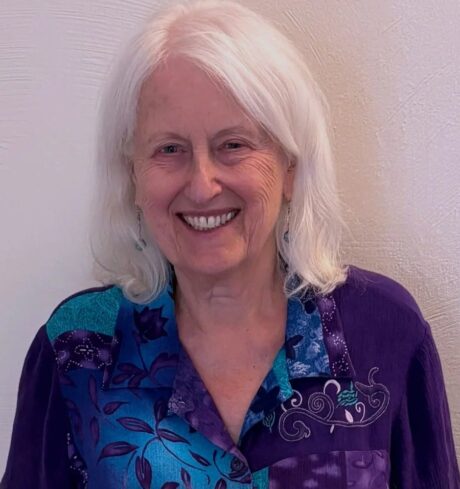
 For years, Evelyn Damashek Varady meticulously researched the lives of her parents, Hela and Janek Damashek, with particular emphasis on how they survived the Holocaust. She combed documents, letters, photos, and interviews with family members to fill in the gaps left by her parents’ reticence and their early deaths: her mother’s when she was only nine years old, and her father’s when she was 22. She knew that her parents fled Krakow the day after Germany attacked Poland and survived the Holocaust in part by living under Polish Christian aliases in Warsaw.
Her father’s brother, Marek, who’d survived the war years with her parents, praised her research but thought the first draft of her manuscript lacked drama. She agreed and decided to take a more creative approach, imagining her parents’ emotions and details of the ordeals they endured.
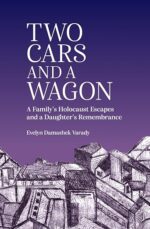
The result is “Two Cars and a Wagon: A Family’s Holocaust Escapes and a Daughter’s Remembrance” (Wheatmark, 2026), which she will discuss on Sunday, Oct. 18 at 4 p.m. at the Tucson Jewish Museum & Holocaust Center.
Although she had known the broad outlines of their stories, she had a breakthrough in 2010, when her stepmother gave her a suitcase full of her father’s papers.
She discovered that her parents’ false identity papers were dated April 1943. They’d survived three and a half years of the war without them.
Throughout the book, Varady is candid about what is invented. She begins with a chapter titled “Hela and Me: An Imagined Conversation,” seeking Hela’s permission to write as if her mother were telling her own story.
“It was extremely important to balance the so-called creative details that documented history, whenever I could, within the narrative, and be transparent about my sources,” Varady says. “In fact, some of what may have seemed creative details were actually based on other people’s memoirs,” such as a list of supplies in the German prisoner-of-war camp where her father, a doctor, treated patients after being arrested in Warsaw in October 1944.
One particularly chilling bit of research she unearthed is a Nazi questionnaire documenting all medical personnel in the occupied areas. With the help of Yad Vashem, Israel’s Holocaust museum, she found the one for Stryi, Ukraine, the town her parents had fled to. With a Jewish star next to her father’s photo, it proved that the Nazis had known her parents’ address in Stryi and that they were Jewish, “and that my grandparents were Jewish, and even the names of my great-grandparents that I never even knew until I saw this Nazi document.”
“I had no idea that they were on the radar of the Nazis for two years while they were in Stryi,” she explains.
In the first half of “Two Cars and a Wagon,” Varady reconstructs her parents’ stories with the tension and flair of historical fiction.
The second half recounts key elements of her life and research, starting with a Yom HaShoah commemoration in Tucson in 1984 in which she and her husband participated, “the beginning of a quest to gain clarity about my identity as one voice in the community of second-generation Holocaust survivors.”
Later, Varady became a docent at the Tucson Jewish Museum & Holocaust Center. At first, sharing her family’s story with visitors was difficult.
“Over time, I’ve come to realize that the darkest, most horrific chapters of history should not be hidden; they are part of our legacy as humans,” she says.
Registration is required for Varady’s Oct. 18 talk at the museum; register here.