

Emily Hager, Director of Programming and Education at the Tucson Jewish Museum & Holocaust Center, wrote her master’s thesis at the University of Arizona on Nazi looting and provenance.
The enormity of the Nazis’ looting during World War II was staggering, says Hager, who learned that “a conservative estimate is 20% of Europe’s treasures were plundered, touched, taken by the Nazis at one point or another.”
She will present a gallery chat at the museum, “Ownership Interrupted: Looting During the Holocaust” on Thursday, Oct. 1, from 11 a.m. to 12:30 p.m.
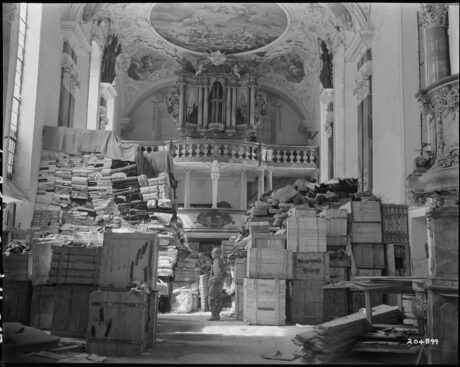
Hager will connect her knowledge of the largest art theft in history to the stories of Holocaust survivors documented in videos and exhibits in the museum’s Holocaust Center.
“We preserve the memory of the 270-plus survivors who made Southern Arizona their home after the enduring the horrors of the war, and we’re so blessed and so lucky to be able to have their generous time and share their stories,” she says. “I’m going to be pulling a lot from their stories, pulling from their own personal experiences of what happened to them during the Holocaust.”
For example, one survivor, Pawel Lichter, who later lived in Nogales, grew up as the son of the movie theater owner in his town in Poland. “The Nazis would come in and pillage his house, day after day after day, and they would take the equipment from the movie theater that his father owned,” Hager says.
Across Europe, the Nazis took everything of value they could find, “from the paintings down to the silver in your grandmother’s china cabinet,” she says.
Even today, 81 years after the Holocaust, museums around the world have gaps in the provenance of many items due to Nazi looting. Researchers continue to help heirs with restitution claims, although in many cases, items like a family’s ritual objects — think silver Kiddush cups or candlesticks — can never be located, Hager says. The Nazis melted large amounts of stolen gold, silver, and platinum objects to fund Germany’s war effort.
Perhaps the most famous restitution case involved the Gustav Klimt painting known as the “Woman in Gold,” popularized by the film with Helen Mirren and Ryan Reynolds.
“That is a perfect example. It was hanging in a museum, and they didn’t know that the heir, the niece, existed even,” Hager says. But because the Nazis were so meticulous in their documentation, they left behind millions of pages of evidence, many with photographs of the looted artworks, which bear witness to the theft, confiscation, coercive transfers, and downright pillaging of property belonging to those they planned to expel or annihilate.
“I’ve always found it very fascinating in trying to understand what an object has been through, because ultimately, what an object is links back to a person, right? Someone owned that; someone created that; someone used that.
“It’s those stories that really drive me, and it really beautifully connects back to the museum because we do preserve these stories,” Hager says.
Ultimately, museum visitors should understand “that the Holocaust is not a closed chapter,” Hager says. Through exhibits and events, the museum helps people understand what can happen when hatred and bias go unchecked, she says.
The gallery chat is free, but registration is required, here.