

I returned Nov. 20 from a whirlwind 10-day rabbinic visit to Azerbaijan and Israel with the Zionist Rabbinical Coalition. Discounting the two days it took to travel to Baku, and one day flying home from Tel Aviv, we had four incredible days in Azerbaijan, followed by two spectacularly full days in Jerusalem and one more in the Gaza envelope area in the south of Israel. The journey felt more like a month than a week and was productive and valuable in many different ways.
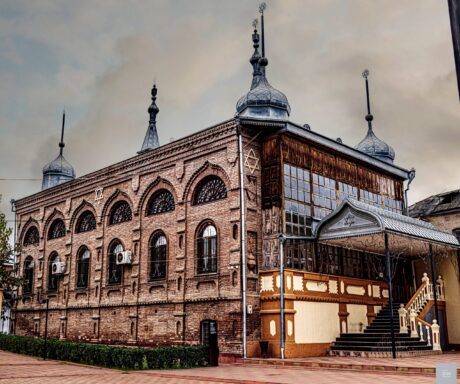
The meetings and briefings throughout the trip were at a very high level, including extended visits with both countries’ respective ambassadors, prominent members of Parliament in both countries, and government ministers in charge of major departments. We met with perhaps the most important advisor to President Eliav in Azerbaijan, the US charge d’affaires in Baku, outside experts in both countries, and with Israeli soldiers, IDF representatives, and other key people in the current situation in Gaza. In Azerbaijan we also visited both of the Jewish day schools in Baku, prayed and enjoyed Shabbat with all three of the active congregations that flourish within a few blocks of each other — two share a building constructed by the government for the Jewish community, each with its own beautiful sanctuary — and traveled to the all-Jewish village in the mountains that was the homeland area for many of the Azerbaijani Jews. In Israel, we spent time at the Foreign Ministry, visited the Knesset and the new Knesset Museum, and had extensive meetings and discussions on the subject of how Israel is trying to grapple with worldwide antisemitism now, and how best we, as rabbis, can address the rising tide of antisemitism and the generational divide we are all experiencing in support for Israel.
When I told people I was going on a Zionist Rabbinic Coalition mission trip to Azerbaijan and Israel, the most common reaction was “Why are you going there?” meaning Azerbaijan. The second most common response was “Where is Azerbaijan?” I, too, had very little idea where Azerbaijan is located, and why it might be interesting or important in the contemporary Jewish world or involved in any way in the life of Israel. There is much to explain and explore about this Shia Muslim nation that is so far from us that its time zone is a full 11 hours later, two hours beyond Israel’s time zone. A former republic of the Soviet Union, Azerbaijan today is a first-world, oil-rich country, and its capital city, Baku, is impressive: magnificent ultra-modern architecture, restored early 20th-century mansions, state-of-the-art museums, a wonderful Old Town dating to the 12th century, and a terrific boardwalk along the Caspian Sea. It even has an ancient Zoroastrian Fire Temple, which I managed to add to the itinerary and visit, discovering it had also been a worship site for Hindus and Sikhs. In ancient Persian, Azerbaijan means something like “the land of the fire-worshippers,” and here indeed they were; the emblem of the country and many of its spectacular new buildings take the form of flames. Baku is a modern city, clean and safe, with excellent roads and beautiful and well-maintained parks, especially when compared with American cities these days. Now that I’ve seen it, I definitely want to return.
But we American rabbis weren’t in Azerbaijan to enjoy the tourist sites. This small nation of 10 million in the Caucasus has the distinction of being the largest Shiite nation with full diplomatic relations with Israel and a Jewish community that dates to First Temple times, perhaps 2700 years ago. Our rabbinical group was in Baku to affirm, on behalf of Zionist American rabbis, our support for its close and positive connections with Israel, to find out more about a nation that might serve as a model for how a 95% Muslim country can establish a warm, mutually supportive bilateral relationship with Israel, and to interact with and learn about its active Jewish community. When we traveled on to Israel, part of our mission was to see the Israeli perspective on Azerbaijan. There were some well-thought-out parallel experiences on our trip: we had a wonderful meeting and dinner at the home of the Israeli Ambassador to Azerbaijan, Ronen Krausz, and in Jerusalem, enjoyed a similarly warm and open discussion and dinner with the Azerbaijani Ambassador to Israel, Mukhtar Mammadov.
To oversimplify how Azerbaijan came to develop such a close relationship with Israel requires a little history. Although it had a history of independence, from 1920 until 1992 it was, like its neighbors Armenia and Georgia, a republic of the Soviet Union. When the USSR fell, it achieved independence. Until then, the substantial revenues for its huge oil and gas reserves had been siphoned off by Russia, and it was a pretty undeveloped nation. All of that changed rapidly. Azerbaijan became an independent nation, and this is important. Although its population is almost all Shia Muslim — the same denomination as Iran — its founding president, Hadar Eliav, the David Ben-Gurion of Azerbaijan, organized it as a secular state, rather than an Islamic or Islamist republic.
There were some severe growing pains, including a disastrous war with Armenia, which was supported by Russia, in which Ngorno-Karabakh, a region with an ethnic minority of Armenians and a majority of Azerbaijanis, was lost to Armenia. The recent renewal of that war saw Azerbaijan recapture Karabakh.
Azerbaijan has strong similarities to Israel, especially in one aspect in particular: it is located in a very, very tough neighborhood. The country borders Russia to the north and east, Iran to the south, and Armenia, their longtime enemy, both to the north and west and as a kind of inserted territory between the main country and Karabakh. Their friendliest neighbor is Turkey. That’s a tough neighborhood indeed, quite comparable to Israel’s challenges. There are no open borders now for Azerbaijan. They have gone to great pains to prevent Iranian mullahs from crossing into Azerbaijan, spreading their doctrines of Shiite Muslim extremism. Azerbaijan has developed a strong and independent military without receiving substantial help from the West or the US. Israel, however, has provided significant support, and we were told often of the gratitude that Azerbaijan feels to the Jewish State for that support. There is a strong commercial relationship with Israel: oil and gas — mostly oil these days; Israel has natural gas — flows by pipeline through Turkey to ports and then is shipped to Israel, which receives most of its oil these days from Azerbaijan. Israel exports technology and high-tech talent and skills to Azerbaijan, as well as substantial military expertise.
When we asked whether Azerbaijan was planning to join the much-publicized Abraham Accords, everyone in Baku said that the Abraham Accords would be a major downgrade in the Azerbaijan-Israel relationship. Both countries accord the other full diplomatic relations. There is already substantial trade between the countries, exchange of delegations, businesspeople from both nations in the other country, tourism, and significantly, close cooperation on intelligence, especially regarding their mutual enemy, Iran. While no would substantiate it officially, there are rumors that the intelligence that allowed Israel to strike the Iranian missile and nuclear sites was spirited out through Azerbaijan.
Iran and Azerbaijan both have populations made up primarily of Shia Muslims; they share many cultural similarities and traditions. Yet Azerbaijan is much closer, diplomatically, militarily, and commercially, to Israel, a nation that is 80% Jewish and has very few Shia Muslims, since Israeli Arabs are either Sunni Muslims, Christians, or Druze. This is highly significant and is recognized as such by Azerbaijanis and Israelis. A Muslim country — officially secular, with separation between religion and state, but still, 95% Muslim — can indeed have an excellent relationship with Israel, one that leads to improved security and prosperity for both nations.
Is this a valuable model for other Muslim countries considering improving their diplomatic relations with Israel? A few days in Baku certainly made the possibility of other nations developing that kind of relationship with Israel seem likely, or at least not beyond imagination.
We had one surprising bashert moment in Baku. On our last full day there, on Shabbat, after services and lunch, we had a walking tour of the magnificent Old City. As we strolled past residences, art galleries, and restaurants built into the ancient city walls and towers, I saw a mezuzah and a Hamsa on the door of one building. I wondered aloud to a colleague if someone Jewish still lived there, and an older man walking up to the place said, “Do you want to come inside?” It was his house, and it turns out, he is an artist who paints portraits of the Jewish victims of terror and IDF heroes who have died in fighting. His portraits were exceptional — I have photos of some — and in our dialogue in Hebrew, he explained that he is motivated to do this work not for money, which he apparently has plenty of, but as a tribute to the lives of these heroes of Judaism. One of his portraits was of Daniel Pearl, z”l, the American journalist murdered by terrorists whose last words were “I am a Jew.” Delegation members Rabbi David and Beverly Woznika, of Stephen Wise Temple in Bel Air, California, spend Shabbat often with Pearl’s father, Judea Pearl, in Los Angeles. It was the kind of small, semi-miraculous thing that can raise a trip from outstanding to extraordinary. The Jewish world can seem very small indeed sometimes.
We flew from Baku to Ben Gurion on one of 21 weekly flights between the countries. There are no longer posters of the missing hostages as you walk through the airport, a welcome change from my last visit in January 2024, when their images — posters, bumper stickers, tableaus, video boards, buttons, and more — were everywhere.
So, what is Israel like now that the ceasefire has been in place, the living hostages have returned home, and all but one of the bodies of Israelis murdered by Palestinian terrorists have come back and been buried?
Frankly, it feels like Israel again. People are more relaxed than they were when I visited in January 2024, a dark time during the Gaza War when the return of the remaining hostages seemed impossible. The sidewalks, museums, hotels, and streets are crowded again — the traffic was often terrible, which in this case is a good thing indeed. I had a great day hanging out with cousins in Jerusalem, taking the train to Tel Aviv, and spending time in parts of that busy city I had never been to. There is great relief in Israel over the ceasefire, and genuine hope for real peace, at least for many people, in the somewhat near future, even while there is tremendous criticism of the government and a powerful demand for a committee of inquiry into what allowed October 7th to take place. Still, it felt very normal.
Israel is an advanced, civilized, highly productive modern nation of 10 million people with a vibrant economy, almost no homelessness, and an active, engaged, highly educated, creative, and innovative population. It is also a place in which every person knows where the nearest bomb shelter is, where most people have a ma’mad, a safe room in their homes that can survive all but a direct hit by an Iranian ballistic missile. Construction cranes are present everywhere as Israel constantly builds more and better buildings and transportation networks, a nation where new developments are everywhere, even while many of its young people joke that their full-time job is now reserve service in the army, which has occupied nearly all their time and attention over the past two years.
The meetings with Israeli officials were valuable, but it also seems clear that while they have strategies for dealing with the continuing threat of Iran and with terrorism in general, the tremendous upsurge in antisemitism in America and throughout the world has shocked the Israeli establishment and they have no real idea of how to address it. It is a crucial question that hasn’t been a priority for this Israeli administration until now, and that we here in the Diaspora are also challenged by in profound ways we haven’t had to deal with for decades. It is also clear that Israel does not have a clear consensus on how to move forward in Gaza and the West Bank beyond the current Trump administration plan, about which there is still controversy in Israeli politics and public opinion.
Our visit to the Gaza envelope was powerful and painful, if also somewhat affirming. Walking through the Nova Festival memorial site, which now sees 5,000 visitors a day, brought me to tears, even though it has been cleaned up to make it possible to see only the photos of the dead, not their blood. Being in the room where the Israeli young women soldiers who were field observers died at the hands of the Hamas Palestinian terrorists, hurt the heart. But hearing the energetic affirmations of young, idealistic Israeli soldiers — people younger than my own older children — who are profoundly committed to the mission of protecting the unified people of Israel restored faith and hope.
I can tell you that it is time to plan to go back to Israel and revel in its incredible energy and accomplishments.
I can see what the Azerbaijanis see: a terrific country to have as an ally.
In our recent Torah portions, we see the initial and longer-term estrangement of two brothers, Jacob and Esau. It often feels like that between the Jewish and Muslim worlds, sibling hostility that has degenerated to terrible and profound violence. But this visit brought me hope that the reunification of family that has occurred between a Shiite Muslim nation, Azerbaijan, and a deeply Jewish nation, Israel, may serve as a true model of peace and cooperation for the future of the Middle East. And who knows? If Jews and Muslims can live in peace, why can’t the whole world?