
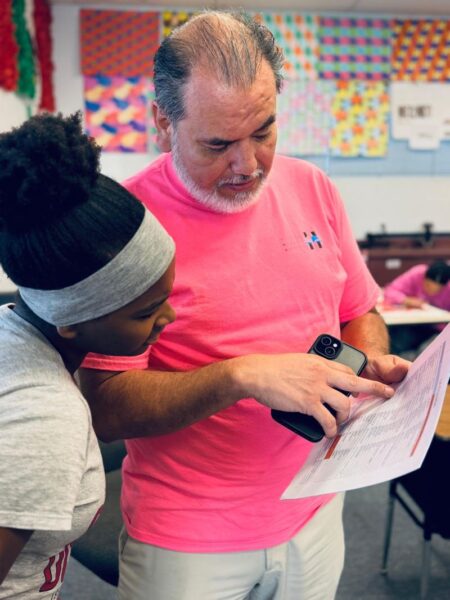
This fall, Tucson Hebrew Academy launched a full-fledged Spanish program, expanding on what was formerly a middle school elective.
On a recent Wednesday, eight students from the fifth, seventh, and eighth grades engaged in a spirited game of Pictionary, reinforcing their vocabulary lessons on food and restaurants as they used a whiteboard to draw everything from scrambled eggs to concepts such as “well done” or “rare” meat and “to leave a tip.” As part of this unit, the students are also creating restaurant menus and will practice conversations that would take place in a restaurant.
“I believe there are three very important aspects to learning a new language, especially during the first year,” says Miguel Montemayor, who teaches the Spanish class in addition to fifth- through eighth-grade math.
“First, students should develop a love for the language through its culture and history. When students engage with music, traditions, and real-life cultural examples, they are more motivated and connected to what they are learning. Second, it is important for students to understand the differences in social and cultural norms so they can communicate effectively and avoid misunderstandings. For instance, learning when to use formal versus informal language is an important cultural skill. Third, students should begin developing conversational skills for everyday interactions, such as greetings, asking for help, shopping, or asking for directions,” he says.
The Spanish program complements THA’s broader commitment to multilingual education. Alongside their Hebrew studies, which are integrated into the curriculum starting in kindergarten, learning Spanish strengthens students’ cognitive flexibility. Research shows that studying multiple languages enhances memory, creativity, and problem-solving abilities — skills that benefit students across all areas of learning.
Montemayor had previously taught the Spanish elective, which met once a week and was designed primarily to expose students to the cultural and social aspects of the Spanish language, he says.
In the elective class, along with basic vocabulary, students explored traditions, food, music, and customs from Spanish-speaking countries.
“For example, we discussed common greetings, practiced simple conversational phrases, and looked at how culture and food influence communication in different regions,” Montemayor says.
The Spanish class now meets four days a week; on the fifth day, the students attend SEL (Social Emotional Learning) with Kate Brownstone, the school counselor. “This provides students with an opportunity to focus on important interpersonal skills, self-awareness, and emotional development alongside their academic learning,” Montemayor explains.
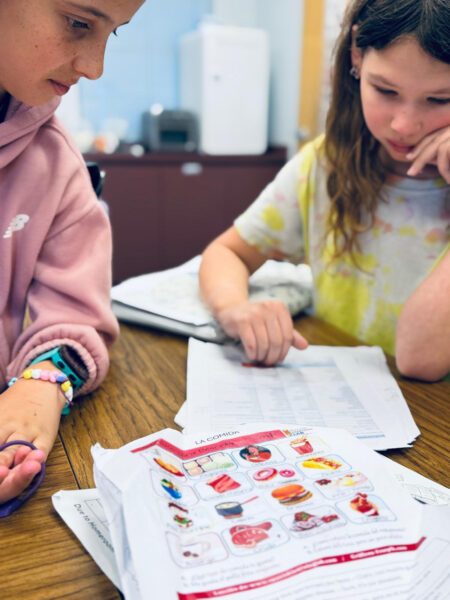
In the Spanish program’s first year, he says, “students are building foundational skills such as basic vocabulary, pronunciation, simple sentence structure, and common conversational phrases. They are also developing their listening and comprehension skills through repetition, practice, and exposure to spoken Spanish,” he says.
During the Pictionary game, he gently corrected students’ pronunciation. A random prompt generator ensured both variety and repetition.
“It does get heated, especially since none of us can draw that well,’ says Eliza, an eighth grader. “This was a chill day.”
Students should leave the Spanish course “with a strong foundation and a positive attitude toward language learning,” Montemayor says. “I want them to feel comfortable taking risks and using the language, even if they make mistakes.”
While the THA website identifies middle school as grades six through eight, the school made the decision to introduce Spanish earlier for some fifth-grade students, Montemayor says, noting that the decision was also influenced by the fact that this year, THA did not have a sixth-grade class.
“Introducing Spanish at the fifth-grade level gives these students a valuable head start. For example, they begin learning basic vocabulary, greetings, and simple sentence structures, which helps them feel more confident and prepared as they move into middle school. Overall, this early exposure allows for a smoother transition and supports stronger long-term language development.”
For the eighth graders, who will be going on to various high schools next year, Montemayor’s goal “is to ensure they feel confident and prepared as they transition into high school Spanish. This includes being able to introduce themselves, participate in basic conversations, understand common expressions, and approach more advanced material with confidence and enthusiasm.”
Avigail, a fifth grader, appreciates the opportunity to learn Spanish at THA.
“I love it so much,” she says. “Mr. M is one of the best teachers. He’s really nice, and he does a bunch of fun stuff.”