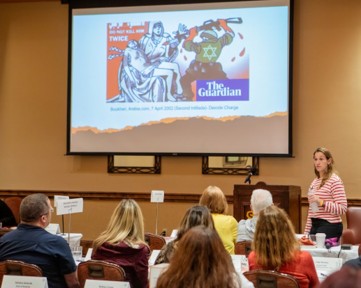
Despite torrential rain, on Sunday morning, Nov. 1, educators and administrators from 22 schools all over Southern Arizona turned up for the Southwest Institute 2026: Protecting Students and Strengthening Schools, a day of learning presented by the Center for Jewish Resilience (CJR) at Jewish Philanthropies of Southern Arizona.
The program started with an overview and history of the Jewish people that explained the Jewish people’s unusual status as simultaneously an ethnicity, a religion, and a civilization rooted in a specific homeland, Israel.
The overview also included an exploration of what antisemitism/Jew hatred is and how it shows up in contemporary life.
Dr. Bar Guzi, head of educational opportunities at Boundless, one of the Institute’s sponsors, explored free speech and antisemitism in schools. He explained that while the law may permit hate speech, educators have a duty to stop antisemitic speech, name it, explain why it is wrong, and check on the affected student, just as they would with any other expression of hatred and bigotry.
But presentations by two local students showed that educators often don’t step up to rebuke antisemitism — or may themselves be the perpetrators.
The first student, now in high school, spoke of a seventh-grade history teacher who used his class time to repeatedly rant about immigration. The student and his parents are immigrants. When the teacher gave a Nazi salute — knowing that this student was Jewish — the student, feeling specifically targeted, began to cry and left the classroom, seeking out his English teacher, who advised him to go grab his backpack. When the student went to collect his belongings, the history teacher tried to prevent him from leaving the classroom.
The school’s response to the incident was to suggest that the Jewish student engage in independent study, which amounted to sitting in the corridor and reading his textbook. His family was not updated about any investigation of this teacher, who is still employed at the school. The student ultimately transferred to a different school.
“A student should not have to lose access to education” because of a teacher’s behavior, the student said. After consulting the ADL, the family decided not to pursue the matter further, said his father, who accompanied him to the SWI.
The second student, now also in high school, was taunted and abused by his middle school basketball teammates. They roughed him up on the court and in school corridors and called him “Hitler’s worst enemy.” In a team group chat, someone wrote they wished his family died in the gas chambers, “I wish Hitler killed you himself,” and called him a “stupid Jew.”
When his family learned what had been happening — the student kept it to himself for a long time — they reported it to the principal and the offending students were told to stop. However, the harassment continued when the students progressed to high school, and eventually the family involved the police.
“I wish adults took it more seriously when it was initially reported. Adults should check in on students more,” the high school student said, adding that it was unfair for a bullied student to have to give up something they loved, such as basketball.
Affirming that being Jewish is an important part of his identity, he said, “I shouldn’t have to choose between feeling proud of who I am and feeling like I belong” at school.
His mother, who accompanied him at the SWI, noted that the principal at first seemed very responsive, but provided no follow-up.
While the family didn’t press charges against the boy who was the worst offender, they made it clear if his behavior toward their son continued, they would.
The students’ presentations prompted a lively question-and-answer session with the educators. When the first student’s father revealed that the principal said, “We know this is a problem and there’s nothing we can do,” there were gasps of dismay all around the room.
Hava Leipzig Holzhauer, JPSA president and CEO, reminded the educators that these antisemitic incidents were just two of hundreds in Southern Arizona that had been reported to, and investigated by, the CJR in the past year, with more than half occurring in schools. (Incidents can be reported here.)
The day program for educators was one of three segments of this year’s SWI, which also included an evening program on Nov. 1 for community members with keynote speaker Dr. Brandy Shufutinsky, and a half-day program on Monday, Nov. 2 for civic, interfaith, and higher education leaders.
The CJR’s SWI 2026 partners are the Arizona Department of Education, Brandeis University, Boundless and the Arizona Center for Judaic Studies
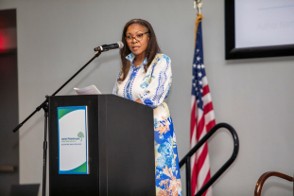
At the evening program, Dr. Brandy Shufutinsky, the education and national security program director at the Foundation for Defense of Democracies, presented “Beyond the Classroom: Who Shapes What Our Children Learn” to Jewish community members and allies.
Dr. Shufutinksy explored how counternarratives to basic historical facts are rationalized and institutionalized, with ethnic studies programs and the politics of intersectionality convincing students that America was built on stolen land and is institutionally racist, and that Israel is a settler colonial project.
In conversation with Dr. Fish, Dr. Shufutinsky explained how ethnic studies programs have been financed by organizations such as the Qatar Foundation International, with the aim of keeping the U.S. and Israel in a state of chaos.
“The entire ethnic studies movement was pushed to teach Palestine,” she said. “Academic achievement is not improved, but thousands of dollars have been spent to teach children a false history that’s leading them to view hating Jews as morally right.”
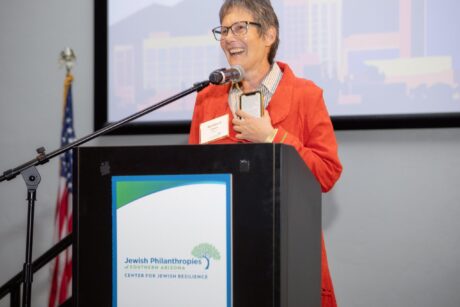
The evening program also included the presentation of the Meyer and Libby Marmis Humanitarian Award to the Friends of Aphasia. A JPSA tradition since 1983, the Marmis award was paused during the COVID-19 pandemic and restarted this year.
“At the heart of the Southwest Institute is the understanding that resilience is built through relationships. It requires more than responding when challenges arise. It means cultivating trust, practicing genuine allyship, and recognizing that the dignity, safety, and well-being of one community are deeply connected to those of another. That spirit is beautifully reflected in today’s Marmis Humanitarian Award recipient, Friends of Aphasia,” said JPSA Director of Public Affairs Carina Bien-Willner.
On Monday, Nov. 2, the Center for Jewish Resilience brought together nearly 30 civic leaders (elected officials, interfaith partners, and University of Arizona leaders) for a half-day session to learn about Jewish peoplehood (including our historical, religious, and cultural connections to Israel) and the history and contemporary manifestations of antisemitism in America.
After a presentation from Dr. Rachel Fish, the group broke into cohorts to discuss steps leaders can take to address anti-Jewish hate and bigotry and build a more inclusive community.
To receive community relations and public affairs updates, click here.