
In the months before Hamas attacked Israel on Oct. 7, 2023, hundreds of thousands of Israelis took to the streets to protest the Netanyahu government’s plans to overhaul and weaken the Israeli Supreme Court.
This attempt at a judicial coup and the attack by the government on democratic institutions is still ongoing, even after the attack of October 7th and the war that followed, and is the most important story in Israel, says Dr. Anat Balint, the inaugural Jeffrey B. Plevan Chair in Modern Israel Studies at the Arizona Center for Judaic Studies at the University of Arizona.
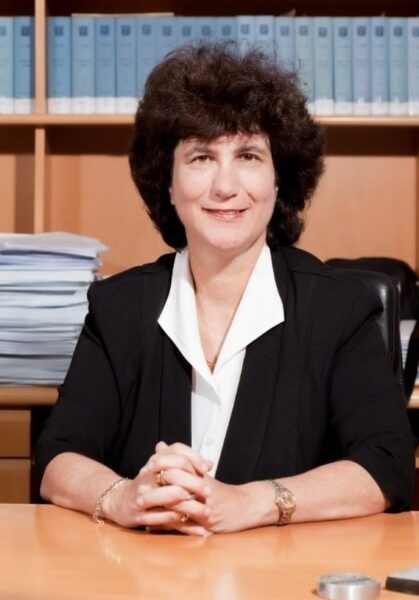
Balint will moderate the Center’s 2026 Jeffrey B. Plevan Memorial Talk, “Justice in the Public Eye: A Conversation with Israeli Supreme Court Justice Prof. Daphne Barak-Erez,” which will be held on Tuesday, Feb. 10, 6:30 p.m at the Tucson Jewish Community Center.
Justice Barak-Erez, a member of Israel’s Supreme Court since 2012, is recognized internationally for her scholarship and jurisprudence in constitutional law, administrative law, and human rights. Her work reflects a deep commitment to democratic governance, judicial integrity, and the protection of civil liberties — issues that have become increasingly central in today’s global political climate.
Serious conversations around democracy in Israel “unfold every day with various legislation attempts, and the Supreme Court is very much at the center of this tension,” says Balint, a media scholar who was formerly a journalist for Ha’aretz and an activist for press freedom in Israel.
Similar conversations are happening in other countries, “the United States included, but also Hungary, Poland, Turkey. These are countries where the basic structure of democracy is being either attacked or challenged by the government,” Balint says, adding that it is an interesting time to talk about how Israel’s Supreme Court deals with these immense challenges.
“Justice Prof. Daphne Barak-Erez told me herself that she sees great importance in coming and speaking to audiences outside Israel, especially Jewish communities, and connecting with them,” Balint says.
Since Israel has a parliamentary system, Balint explains, the Supreme Court “has a very important role of overseeing government decisions and legislative decisions and making sure that they’re not stepping over the value of equality that is at the heart of the rule of law, the rights of minorities, that new legislation does not contradict the Declaration of Independence, and so forth. So they have the power to, in rare cases, overrule laws that were passed by the Parliament.”
Among questions that will be discussed during this evening — within the limitations of Justice Barak-Erez’s role — are drafting the ultra-Orthodox into the Israeli army and efforts by the minister of national security, who has a criminal record, to intervene with the work of the police, for political purposes.
While there are tensions between the Jewish communities in Israel and the U.S., Balint notes, at the same time, there is a very strong sense of connection, solidarity, and shared destiny.
“What I try to do in my role at the U of A is to bring Israel from within, the reality of it, to American audiences, to bring perspectives closer together,” she says, adding that because Justice Barak-Erez is such an outstanding scholar, the Feb. 10 event is a prime opportunity to do just that.
“Welcoming Justice Prof. Daphne Barak-Erez to Tucson is a true honor,” says Yuval Malka, Senior Community Shlicha. “She’s not only one of Israel’s most respected legal scholars, but also the highest-ranking woman currently serving on Israel’s Supreme Court. As an Israeli woman — and as a woman in general — witnessing her strong leadership is incredibly inspiring.”
“Israel’s democracy is alive, challenged, and evolving, and I’m grateful for the chance to bring that perspective to our wonderful Tucson community. Sharing the lived Israeli experience — with all its complexities and nuances — is deeply meaningful to us at the Weintraub Israel Center, and to me personally,” Malka adds. “Bringing that reality into our community isn’t just an educational opportunity, it’s a chance to build a real and lasting partnership between Israelis and American Jews.”
To register for the event, which is co-sponsored by the Weintraub Israel Center, the UA School of Global Studies, and the UA James E. Rogers College of Law, click HERE.