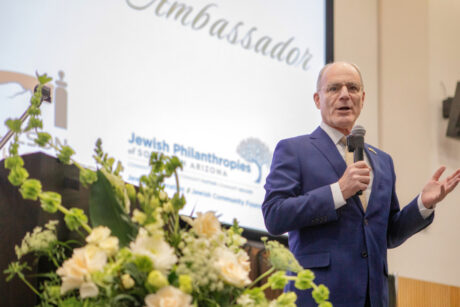
More than 600 people turned out to hear H.E. Dr. Yechiel Leiter, the Israeli ambassador to the United States, speak in Tucson on Sunday, Feb. 1.
The ambassador was in town to dedicate a Torah in memory of his son, Maj. Moshe Yedidya Leiter, an Israeli physician and soldier who was killed while leading IDF forces into battle in Gaza in November 2023. The new scroll will belong to the Tucson Torah Center, which two of the ambassador’s nephews, Rabbi Yehuda Palgon and Rabbi Yehuda Leiter, helped start less than three years ago. Rabbi Palgon emphasized Sunday that the event could not have happened without the partnership of the Tucson Jewish Community Center, which hosted the event, and Jewish Philanthropies of Southern Arizona.
“It’s very unusual to have a sitting ambassador visit Tucson, and we’re honored that he’s here to speak with our community,” said Hava Leipzig Holzhauer, JPSA president and CEO.
Before the ambassador spoke, Rabbi Palgon filled in the backstory of how the Torah completion and dedication came to take place here.
It began with a Jewish philanthropist from Chicago, Dudi Berkowitz, visiting Israel, moved by the stories of Israeli soldiers killed in the war that followed the events of Oct. 7, 2023.
Paying a shiva call at the Leiter home, Berkowitz told the grieving father, “It would be really nice if we would dedicate a Torah in memory of your son.” The Leiter name had rung a bell with Berkowitz, who studied 30 years earlier with Yechiel Leiter’s brother, Rabbi Chaim Leiter.
This was about three months before Yechiel Leiter was appointed ambassador.
Nine months after that shiva call, Rabbi Palgon and his brother-in-law, Rabbi Leiter, visited Chicago and met Berkowitz, who’d had the half-promise he’d made in Israel nagging at the back of his mind.
He told them, “I wanted to donate the Torah in memory of your cousin and your uncle’s son and your father-in-law’s nephew.”
The Torah was written by an Israeli scribe and sent to Tucson.
“This whole episode,” Berkowitz said, “from my unprompted pledge to a stranger, to its fulfillment months later in Chicago to rabbis from Arizona, was the Hand of G-d in action. This Torah, and all of the significance it represents, was clearly meant to find its home in Tucson.”
“This is Providence at work,” Rabbi Palgon told the crowd at the dedication ceremony.
After expressing her gratitude to all who helped plan the event, and to community rabbis, civic leaders, and others in attendance, Leipzig Holzhauer introduced the ambassador. She highlighted his previous roles, including advisor to Prime Minister Ariel Sharon and Chief of Staff to then-Finance Minister Benjamin Netanyahu, as well as his scholarship: degrees in law and political science, a master’s in international relations, and a PhD in political philosophy, with his thesis, “John Locke’s Political Philosophy and the Hebrew Bible,” published by Cambridge University Press.
Memories and Miracles
Amb. Leiter immediately put the crowd at ease by explaining that he’d be walking around the stage not because he had shpilkes, but because he’d been summoned to Israel for a security meeting the previous Thursday, following the news that the body of hostage Ran Givli had been found. Sixteen hours in a plane followed by two hours in a car to reach Tucson had aggravated his sciatica.
He spoke of three Torahs dedicated in his son’s memory. He participated in completing the first in a shul in Krakow, Poland, during a March of the Living trip, along with the father of an Israeli soldier who fell on Oct. 7.
“We’re both grown men with children and grandchildren, bawling our eyes out,” the ambassador said, describing how the scribe helped them fill in letters that corresponded to their sons’ names.
Noting that the other man’s family came from Yemen, while his own was from Eastern Europe, the ambassador told him, “We’re a people. We had no connection with each other for 2,000 years. We come back together, here at Krakow, after our Holocaust, and we end in the same Torah … We’re experiencing a miracle.”
The second Torah he mentioned was one his deputy suggested for a shul the ambassador created in his Washington residence after he realized there was no shul nearby.
This scroll was written 400 years ago in Prague, one of almost 2,000 Czech scrolls collected by the Nazis and rescued after World War II by the Memorial Scrolls Trust in London.
“We call it a living Torah. March of the Living. Think of that every time you open the Aron Kodesh and march up to the bima,” Amb. Leiter said.
The third Torah was connected to his son’s courage and persistence, not only as an IDF Special Forces officer, but also in light of his decision to attend medical school at age 33 after seeing Israeli doctors rescue people from the rubble of an earthquake in the Philippines in 2014. Moshe told his father that after 15 years of learning how to take life, he wanted to give life.
While in medical school, Moshe not only did up to 100 days of reserve duty in the IDF each year, but also led a program to integrate Haredi men who wanted to enlist in the intelligence corps.
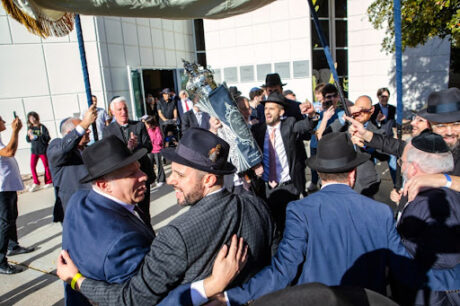
That program recently dedicated a Torah in Moshe’s memory, the day after his second yahrzeit. The ambassador described the mix of ecstatic joy and tears as 1,000 soldiers danced with the Torah, and one who had lost his legs in the explosion that killed Moshe came in his wheelchair and lifted the Torah high.
The ambassador concluded his talk by discussing the miraculous resilience of a people “exiled from its land 2,000 years, spread to the four corners of the earth, persecuted in every place they’re exiled to [who] experienced the greatest crime committed by mankind to mankind just 80 years ago, to come back to their land and be so consequential that people all over the world are obsessed with this tiny, little country that could fit New Jersey with some extra space.”
“Is that not a miracle?” he asked, continuing, “You are part of that miracle. And people who support and stand with us, the American administration, the American Congress, the American public, are part of that miracle.”
“And when our soldiers go to protect and defend, they’re going to protect and defend that miracle.”
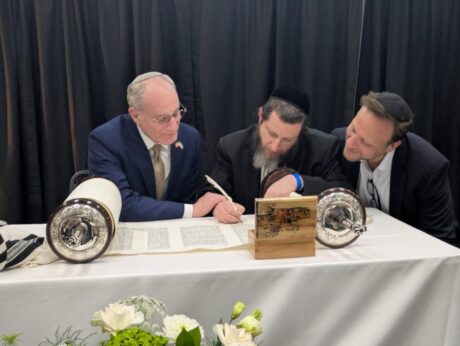
Following the speech, Berkowitz and Amb. Leiter completed the final letters of the Torah with a scribe from Chicago, Rabbi Tzvi Bider, as the audience watched, enrapt.
Participating in the Mitzvah, Sharing the Joy
The event began with members of the community participating in the mitzvah of writing a Torah, joining the scribe as he filled in a missing letter, word, or phrase.
Alayne Greenberg and her husband, Bruce, were among them, motivated in part by the memory of their son, Tzadik, whose second yahrzeit is coming up next month. They contributed to different portions based on their children’s bar mitzvah dates. For their daughter, Anna, who died in 2013 after battling cancer, they chose the Sh’ma.
“On her deathbed, when she called the family together, we did the Sh’ma together,” Greenberg said. “She died on the very last word … we were able to witness it, it was beautiful, sad to lose her, but her life was complete.”
Participating in the completion of a new Torah, “it’s like Torah come alive,” she added.
Among the hundreds of guests were 30 who flew in from out of town for the Torah completion ceremony.
Rabbi Shaul Opoczynski from Yeshiva Chofetz Chaim in Queens, New York, said, “To see so many people that are coming in support of Judaism, of the Torah, of Israel, I’m taken by the impact that Tucson Torah Center has had on the Tucson Jewish community.”
Tucsonans were also awestruck by the occasion.
“This was very inspiring and totally emotional. Honestly, I’ve never seen a Torah completed. I’ve done a lot of Jewish things, and that’s a first for me, and it did feel like a miracle. I’m glad they brought it to Tucson,” Carrie Goldhoff said.
Rabbi Samuel M. Cohon, one of at least 10 Tucson rabbis present, was particularly touched by the story of the Czech scroll because his great-uncle, Rabbi Harold Reinhardt of London, was instrumental in saving those scrolls.
“I think it’s wonderful that that Torah is being read regularly at the shul in DC that the ambassador created,” he said.
For Rabbi Yehuda Leiter, “It was the first time in my life, my young life, that I experienced personal tragedy, having lost my cousin, somebody who I knew pretty well, even though I grew up in America and he grew up in Israel.”
Despite his grief, Rabbi Leiter focused on the opportunity “to create the most powerful and dynamic Jewish experience for our community, which is going to leave a memorable impact for everyone who attends, for everyone to walk away feeling more connected to their Judaism, to feel more connected to Israel, and to feel, most importantly, more connected to each other.”
Seeing so many new faces at the dedication event, he said, “reflected the partnership of the JCC and JPSA and the reach that they have. I think it also reflects on the greatness of the broader Jewish community, how they’re willing to come together, and intrigued and curious and wanting to connect and wanting to grow.”
They were met, he said, with an event that combined writing a Torah, “our ageless and timeless treasure,” with hearing from the ambassador, “which is something that is probably for many, once in a lifetime, to hear a dignitary of that stature.”
Looking around the room as his uncle began to speak, he says, he had a moment to appreciate “the divine direction that we were given. And the only thing I could think of is, it’s in the merit of my cousin who was such a great connector and a unifier and just embodied standing up for the Jewish nation, standing up for the homeland, standing up for our heritage.”