In August 2025, the Anti-Defamation League (ADL) launched the Jewish Policy Index (JPI), an interactive tool to evaluate state-level efforts to counter antisemitism through laws, education and public policy. According to the ADL, the JPI was created in response to an increase in antisemitic incidents in recent years.
In 2024, ADL tabulated 9,354 antisemitic incidents across the United States. This represents a 5% increase from 2023 and a 344% increase over the past five years. It is the highest number on record since ADL began tracking antisemitic incidents 46 years ago.
The ADL sent letters to governors outlining the JPI and one of its top recommendations was establishing an antisemitism working group to help drive meaningful policy solutions.
Sarah Kader, deputy regional director of ADL Desert in Arizona, met with Gov. Katie Hobbs’ office on several occasions and developed a plan to organize such a group for Arizona. The result is the Advisory Council on Jewish American Affairs.
“We wanted to be sure that the council was representative of Jewish life in Arizona — geographically and religiously diverse,” said Kader.
Kader said the ADL made recommendations based on the experience of other councils created across the country but, ultimately, the decision of who would be part of the panel was up to the governor.
“There’s a greater understanding of the issues facing the Jewish community and Jewish communal life is improved over time, and policy outcomes also improve when these councils exist,” said Kader.
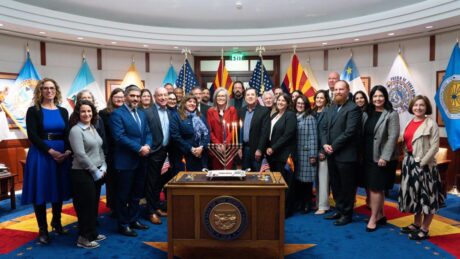
On Nov. 19, 2025, more than 20 members of the Jewish community, including rabbis, Jewish professionals and community leaders, and members of Hobbs’ staff, gathered for the first council meeting in downtown Phoenix. (The council also gathered for a security briefing after the attack at Bondi Beach in Australia and for a menorah lighting on Dec. 17).
Hobbs started the meeting by acknowledging the rise of antisemitism and that it goes without saying there is no place for it in our state.
“I will continue to speak up when I see it happening. People deserve to go to school, to work, to live in their communities, to worship and be safe doing so,” she said. “And we certainly will rely on all of you to be our eyes and ears when you see things happening.”
She also said she wanted the council to be about more than antisemitism and that her office is always looking for ways to be a better partner to the Jewish community.
Andrew Kunsberg, board of trustee member of Jewish Philanthropies of Southern Arizona (JPSA) in Tucson, explained that he is involved with the Center for Jewish Resilience that was created by JPSA to counter the misinformation and demonization of Israel and Jews after the Hamas attack in Israel on Oct. 7.
“We’re dealing with several areas of antisemitism,” he said. “And our major concern is K through 12th grade. There’s a huge increase in antisemitism in the schools.” He also said that he felt teachers, and legislators, should be required to take a class in antisemitism.
Hava Leipzig Holzhauer, JPSA president and CEO, is also a member of the governor’s advisory council.
Rabbi Stephanie Aaron of Congregation Chaverim in Tucson shared that in her b’nai mitzvah class, two of the children told her that the day before, at their public middle school, other children said “Heil Hitler” to them and also called them “kike.”
Then, one of her students who attends Jewish day school asked, “Rabbi, what’s a Heil Hitler?”
She said that although it is nice that the children who attend Jewish day school are protected, the other kids are getting hit with antisemitism constantly.
“Since Oct. 7, they have continued to educate teachers about the Holocaust, saying here’s the Holocaust, here’s Oct 7. What’s in between? Well, we don’t know,” she said.
“We’re not saying a word about it because it’s political. And for me, that is a huge problem to say that we can’t talk about antisemitism currently because of what’s happened because of Israel and Hamas.”
Kader said the intersection of politics and antisemitism is being described as a horseshoe. “We’re seeing it on the right. We’re seeing it on the left,” she said.
She added that as it continues to grow, antisemitism isn’t on the margins anymore, it’s part of daily life for many. “It’s in our schools, our children are experiencing it, and I think one of our main messages is we need non-Jewish leaders to be screaming from the rooftops, like we are.”
Becca Norton, senior Israel advocacy and engagement director Southwest region of Jewish National Fund-USA, admitted that her top priority is education, and agreed it has to go beyond Holocaust education.
“I think (we’re) teaching an entire generation about a topic that is important for them to understand, but feels so distant,” she said. “When we teach Black history, we don’t just teach slavery. We talk about heroes like Martin Luther King Jr. and Rosa Parks. We have to be infusing more positivity into the education, and it has to start early.”
At this point, Hobbs shared that she was very proud to have signed legislation requiring Holocaust education in Arizona schools. In 2024, she strengthened existing requirements for Holocaust and genocide education by changing it from a general requirement to a legally defined minimum time commitment and frequency.
She said that she hears from her two sisters, who are teachers, daily that they are strapped and need resources.
“Finding ways to help get those resources into the classrooms, that’s why the (Hilton Family) Holocaust Education Center is so critical, and will be a resource for teachers, primarily here in Phoenix,” she said. “I’m hoping that we can work together to help provide some of that support in the classrooms that goes well beyond Holocaust education.”
Talli Dippold, executive director of the Hilton Family Holocaust Education Center, thanked the governor for her support of the center, stating that, “The fifth largest city is now going to have a world-renowned education center.”
Hobbs signed a state budget that included $7 million in state funding for the center.
“We’re very fortunate that because of our location, we have an opportunity to teach about Jewish culture, who Jews are,” said Dippold. “Ninety-eight percent of our visitors will not be Jewish. We really want to ensure, especially in a post-Oct. 7 reality, that students are also exposed to who Jews are, as opposed to just also sharing what happened to them during a specific period of history.”
Dippold added that the center is working on publishing a guide on helping administrators and educators address antisemitism in their spaces and is planning meetings with school superintendents to share that information when it is available.
“I think it’s also a very common experience that falls on minorities to educate the others,” said Debbie Yunker Kail, executive director of Hillel Jewish Student Center at Arizona State University in Tempe.
“I’m really interested in ways that the governor’s office could help us rebuild some of those communal connections, whether it’s through different programs that encourage collaboration or folks just getting to know each other,” she said.
She mentioned that the 18-year-old students she works with are being asked to speak up when they see antisemitism in their classroom, yet these same students are asked to take a test on Yom Kippur.
“There are these rules that are protected, but they’re not being enforced universally,” she said. “And I wonder, as a society, how is it we have these structures (in place) but they don’t seem to be protecting the individuals that they’re supposed to protect.”
Eddie Lange, interim executive director at University of Arizona Hillel in Tucson, admitted that he naively thought his job “would be helping the students celebrate Jewish joy and it turns out more like 75% of my time is now dealing with the administration,” which he said is always willing to meet with him and the students.
He added, “What I’m finding in my meetings is that while the structure may exist, while the rules may exist, there isn’t teeth behind them. Whether it’s enforcing the IHRA definition (International Holocaust Remembrance Alliance’s non-legally binding working definition of antisemitism, adopted in 2016 and used by many organizations) or required antisemitism training, I think even when they’re seeing it in the classrooms and the students report it, the deans don’t know what to do with it and it just doesn’t go anywhere.”
ASU student Jacob Marson, who was involved in ASU’s student government during the Oct. 7 attack on Israel, thanked the governor and the presidents of the Arizona universities for standing with the Jewish community at that time.
“After Oct. 7, it was almost like we were talking with a real government, a real United Nations-type body. And any help that you can provide to continue the partnership with university presidents and university leadership, would be greatly appreciated,” he said.
Despite the heaviness of many of the examples discussed, there was one comment near the end of the meeting that shared a lighter perspective.
“It’s really important that with all of these obstacles, we still be able to create Jewish joy,” said Danielle Gross, vice chair of the Center for Jewish Philanthropy of Greater Phoenix and Political Chair for AIPAC (American Israel Public Affairs Committee). “We need to still be able to prioritize that and create a safe place that people aren’t going to be scared to come out and be able to celebrate their Judaism.”
She stressed the need to work together as one community and strategize to find the solution to these collective problems.
In closing, Hobbs said that what she heard during that meeting would weigh on her.
“It can’t just be up to the Jewish people to educate and to make sure that people behave properly. You can’t legislate that. You can’t pass laws that make people be better people,” she said.
She admitted to always taking her bully pulpit very seriously and that it is incumbent on elected leaders to set the tone, to lead by example and she intends to continue doing just that.
“This conversation is very much part of my resolve there. I want you all to know that. And this is the start, not the end. I appreciate all your willingness to come together and help address these issues,” she said.
Reprinted from Jewish News. Mala Blomquist is on Gov. Hobbs’ Advisory Council on Jewish American Affairs.