
Downsizing is not simply a “rehoming” of old possessions: the shoes that are too tight … the extra set of silverware that has been packed away in the closet for 20 years … the scrapbook with pictures from 12 years at camp.
To me, downsizing is a metaphor for aging.
Yes, it is a process that requires decluttering, or culling many of our possessions, in order to move into a smaller living space. But it also relates to our personal relationships, daily activities, and expectations. As we age, our world contracts, and we are forced to make peace with the losses, changes, and unrealized hopes and dreams we have been carrying with us.
It begins with our social circle.
In an earlier essay in the Arizona Jewish Post (“A Tucson Portrait: And Then There Was One”), I talked about my mother’s last living friend, who sat in an empty row at the synagogue and shut her eyes so she could make believe her six widowed friends were still alive and sitting there with her.
I don’t know about you, but my social circle has definitely been shrinking as family and friends have died or moved elsewhere.
In January, I traveled to New York City to spend time with a friend who has a cancerous brain tumor and was about to go into hospice. Margo is one of the few close friends I have left. We keep in touch by phone, but her participation in our calls has become more difficult with each succeeding day. As she is far away, my visit was in many ways a goodbye. I probably will not see her again, and I am feeling her loss already.
My neighborhood is also changing as older residents die or move away. Last month, a neighbor across the street sold her house after 25 years in Tucson, moving east to be closer to her brother. Another loss in our closely knit circle of residents. That makes six in just a few months.
And how do we sustain our social life when evening events become out of reach? So many older people stay home once the sun goes down. Downsizing.
This fall, that issue became particularly challenging for me. I had never thought twice about an evening concert or driving to Friday night services at my synagogue. But in the last six months, I noticed that I was experiencing unexpected stress when I drove at night, straining to see clearly and not as confident in my driving as I was during the day.
Occasionally, I had accepted a ride to and from services. But many weekends, when necessary, I drove myself.
One Friday night in January, in addition to the darkness, I also felt vulnerable as an 87–year-old woman alone.
The driver behind me kept blasting what sounded like a foghorn. Then he started yelling at me as I drove down Speedway Boulevard on my way to services. I was so rattled that I skipped Country Club Road and turned on Tucson Boulevard instead. By the time I reached the synagogue, I was shaking.
After this incident, I decided to forgo night driving altogether and find a friend who could take me to and from services. Zoom does not do it for me. And Uber’s reputation as a safe alternative has been questioned in several articles in the national media.
What is happening to me, I questioned? I decided to call it “creeping dependency.”
This problem will be exacerbated when I have to hand over my car keys and am totally dependent on others to get around.
Many years ago, as a geriatric social worker, I dealt with several clients who would not give up their car keys. Some, like my mother, seemed unaware that their mental decline impacted their ability to navigate safely and successfully. In my mother’s case, her friends allowed her to be the designated driver. AT NIGHT. I was fearful she would hurt herself or someone else. At my urging, my mother finally relocated to be closer to my brother and her remaining friends in New Bedford, Massachusetts, and gave up her keys.
Recently, in conversation with a friend who is considered legally blind, she admitted that her car is sitting unused in the garage. “I loved that car!” she said, with nostalgia. But more to the point, her inability to let go of her car represents her refusal to accept her growing dependency.
Other physical limitations also impact our social lives. My husband, Shelby, suffered from severe hearing loss. Although he had two hearing aids, he struggled to hear in every venue. With all his other health problems, hearing loss was the most painful for him. Here was a very intelligent man who could no longer sit in committee meetings or social groups, as the cacophony of voices made following and participating in conversation impossible. “People think I’m stupid,” he complained.
And so, his involvement in many activities ended. I was particularly hurt seeing my music-loving husband, a former violinist/trombone player, struggle to hear music as written. Not one to complain, he stoically joined me at the symphony in spite of his significant loss in appreciation.
And what about unrealized hopes and dreams? More downsizing.
I will never get to Bhutan or Easter Island. The barge trip on European waterways may not be a realistic option for me right now. And do I have what it takes to travel to Israel one more time to visit my son and his family, who are there for two years? I don’t think so. I heard the disappointment in my son’s voice when I told him I would not be going to Israel this spring. Hopefully, they will come home for the summer. Maryland is more doable.
And finally, to get back to the more traditional use of the word downsizing …
My house is about 1640 square feet. As I push 88, I believe I should be thinking of the future. Although I have made no decisions as to where I will go next … stay in Tucson or relocate near my daughter in Portland, Oregon, or my son in Silver Spring, Maryland, I think about how much space I will have … 800, 600, or 525 square feet, if I am lucky. I know that day will come, probably sooner rather than later.
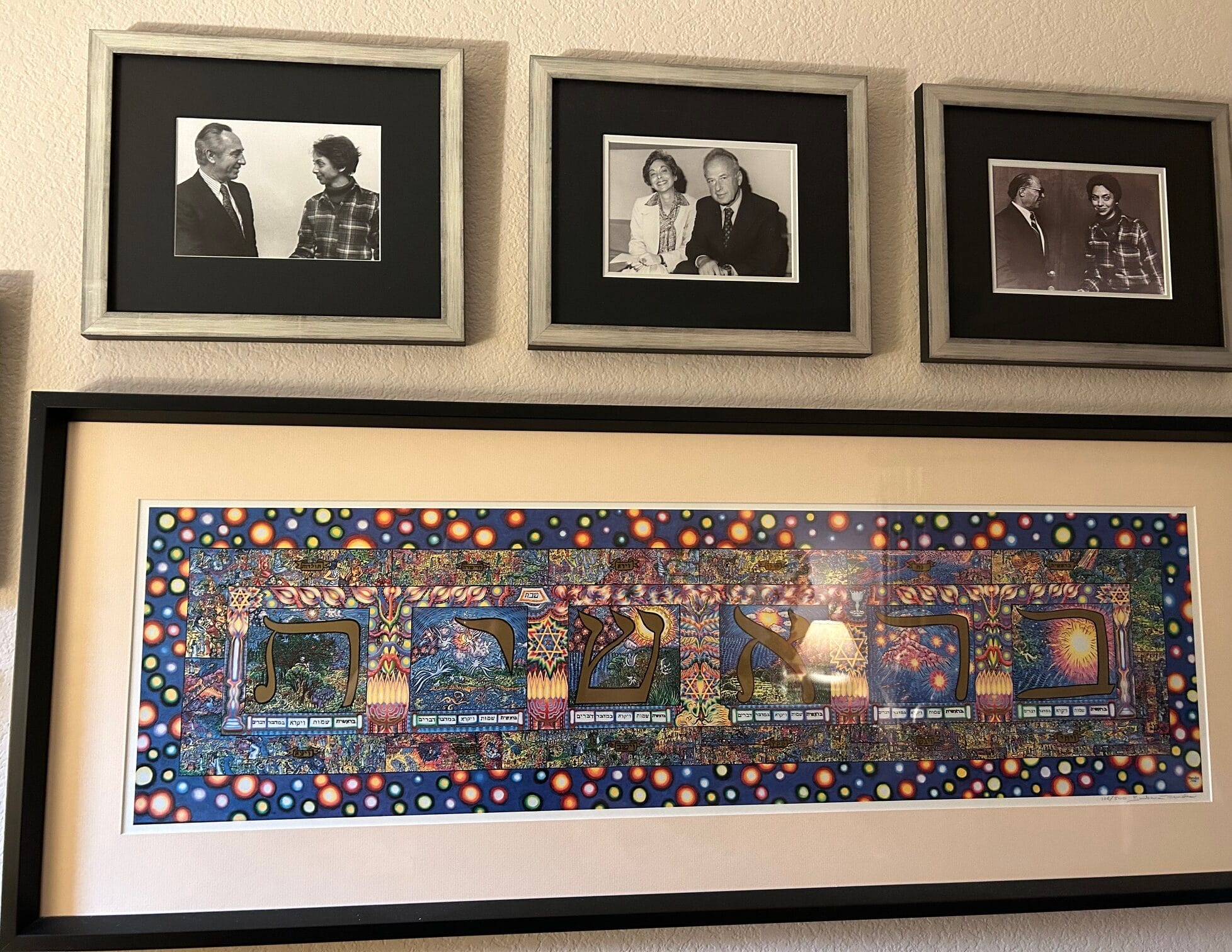
When I look around the house, I am thinking, what will I be able to bring with me? Artwork, books, my menorah collection, an archive of articles written over the course of my life, pictures capturing highlights of my career?
I find children may take a few things, but they want to make their own memories. And who can blame them?
A real irony….
As I wrote these last paragraphs, my phone started ringing. The identified caller was A Place for Mom, an organization that helps you find alternative living arrangements when you are ready to physically downsize. Is someone trying to tell me something?
Judith Manelis is a writer, editor, and journalist whose work has appeared in American Jewish newspapers and magazines. Her book “This Shall Tell All Ages: Art, Music and Writings of the Holocaust” was published by United Jewish Appeal.