
 Keynote speaker Tessa Veksler was thrilled to arrive at the Jewish Philanthropies of Southern Arizona Women’s Philanthropy Connections brunch on March 8 and find a mirror emblazoned with her hashtag: #werenotgoinganywhere.
Inside, more than 250 women were equally jazzed to hear from Veksler, a passionate Jewish and Zionist activist who came to national attention when she faced down antisemitism as the student body president of the University of California, Santa Barbara.
While “We’re not going anywhere” is one of Veksler’s best-known slogans, Connections Co-Chair Monica Rudner was moved by another statement she made, “I live in a country where I can be as Jewish as I want to be,” expressing her appreciation for the choices available to her — choices her parents and older brother did not have until they emigrated from the Soviet Union in 1990.
“When I first heard these words from Tessa,” Rudner said, “they didn’t just resonate; they stirred something deep inside me. They reminded me how sacred that freedom is. How fragile it can be.
“For so long, America felt steady, stable, a safe place for Jews,” said Rudner, who comes from an immigrant family herself and grew up with the message that safety is “precious and not guaranteed.” Only recently, she said, did she realize that not everyone grew up with the idea that “we have left [our home] once before, and if ever need be, we can do it again.”
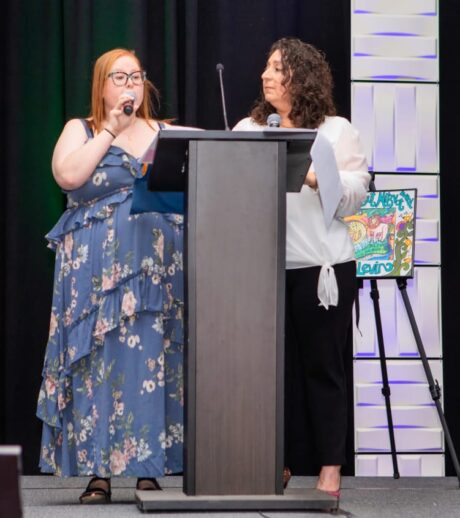
Co-Chair Adina Karp noted that “October 7th shifted something. It woke up stories we grew up with, stories of caution, resilience, and survival.
“And Tessa understood that immediately,” denouncing Hamas while many of us were still processing our shock and grief, Karp said. The backlash was swift, from demands for Veksler’s resignation as student body president to violent threats, yet she stood firm.
“I knew Tessa was the person I wanted our community to hear from because her story is not only about resilience, it is about responsibility. It reminds us that courage is not just an idea discussed. It is lived,” Karp said.
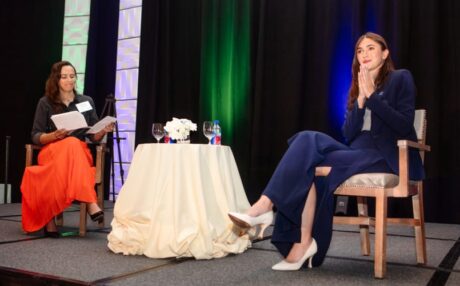
Veksler, who graduated from college less than two years ago, “has emerged as a powerful voice confronting antisemitism and defending Jewish identity and Jewish life,” Hava Leipzig Holzhauer, JPSA President and CEO, summed up, introducing a conversation between Veksler and moderator Melissa Spiller-Shiner, a Tucson attorney and associate director of Step Up to Justice.
Veksler shared details of her background and activism, explaining that she grew up in a Russian-speaking home that was very secular. She did go to Hebrew school on Sundays but also went to Russian school on Saturdays, so she was in school seven days a week.
When she was 17, she went on a monthlong trip to Israel that was “transformative,” she said, and led her to a gap year in Israel, where she had the experience of running to bomb shelters because of war with Hamas. During her gap year, she studied at Bar Ilan University while remotely completing her first year at UCSB.
Returning to Santa Barbara, Veksler became involved in student government and served as president of the student body for her senior year.
She went into the role thinking of herself as “a proud Jewish woman in a non-Jewish space,” with plans to focus on issues such as mental health. She emphasized that she was openly Zionist when she was elected, having served as president of Students Supporting Israel.
“So I didn’t come out of some Zionist closet. Everybody knew,” she told the Connections audience.
But the Oct. 7 attack in Israel changed everything.
Veksler condemned the attack in an Oct. 8 Instagram post, and there was an immediate push from UCSB students to have her removed from office. Suddenly, “my merit and my character, none of that mattered,” she said.
Yet it was only after five months of harassment and antisemitic incidents that Veksler posted about it on social media. A photo of her with a sign saying “No Zionist Allowed” that had been hung in UCSB’s multicultural center, where Veksler had her student government office, went viral. Jewish celebrities, including Michael Rapaport, Debra Messing, and David Schwimmer, reached out with messages of support.
“It kind of launched me into this advocacy work, but it was definitely not my plan,” said Veksler, who had intended to go to law school. “It’s where I ended up, and it’s where I continue to be, because I think that this is the most urgent issue right now. … Everything else can wait.”
Veksler, who is suing UCSB for failing to protect her from antisemitism and harassment, said, “The one benefit of the doubt that I give the university administration is that they were not equipped to deal with what they were given.”
Every university in America should have a definition of antisemitism in its student code of conduct, she said, so it can expel, suspend, or otherwise hold students accountable for their actions. Most do not.
Her own university, she said, offered solutions such as a therapist to help her deal with the situation, which “focused more on me being the problem for my reaction.”
“God handcrafts challenges,” Veksler said, explaining she had to change her mindset from “why is this happening to me” to “this is happening for me.”
“Why is there a Jewish student body president on a college campus, at the time when Jewish students need it the most?” she asked.
But being called a hero is puzzling, Veksler said.
“It’s interesting that it’s an act of heroism to be who we are. It shouldn’t be, because, again, for anybody else, it wouldn’t be, but for us, it is.”
Veksler appeared in the film “October 8,” which dealt in part with American universities “being funded by our greatest adversaries,” including Iran.
“October 8” director Wendy Sachs, she said, is working on a new film, “Poison Ivy,” that will focus on this issue.
Nevertheless, Veksler advised young people in the room not to choose a university based on concerns over antisemitism.
“I would be the person to tell you that you can choose your university, just like every other American teenager chooses theirs,” she said, noting that UCSB had been known as the only UC school that didn’t have a resolution about divesting from Israel.
“You can’t predict what antisemitism will look like on any college campus,” she said, advising students instead to “fill their Jewish cup” by engaging in Jewish life on campus. She also suggested they prepare by “being curious” and “reading the right books and following the right people and listening to the right podcasts,” noting a book list on her Instagram page that is useful for all ages. Her final bit of advice was to “carry yourself with pride” no matter what space you are in.
Holly Gorelik, a Connections attendee who emigrated from Ukraine with her family in 1978, found Veksler’s story of growing up in a Russian-speaking household, knowing little about her Jewish identity, completely relatable.
The events of Oct. 7 inspired Gorelik, a speech therapist who moved to Tucson with her husband and daughter in 2004, to seek a deeper connection with the local Jewish community. Impressed by the Connections event, she immediately sought more information about JPSA and plans to get involved with its Jewish Healthcare Network as well as Women’s Philanthropy.
Bryna Zehngut Mitzvot Award Winners Honored
A beloved Connections tradition is the presentation of the Bryna Zehngut Mitzvot Award, which honors Jewish teenage girls who demonstrate Jewish values and leadership in the spirit of Zehngut, a community leader who died in 2005. Her friends created the award to honor her memory.
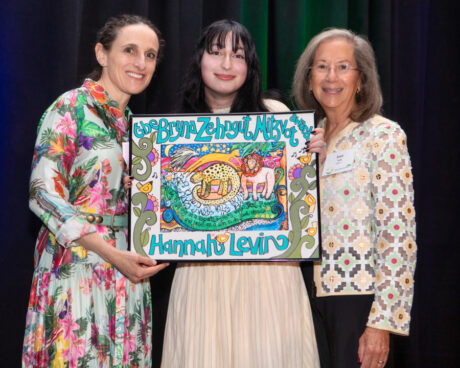
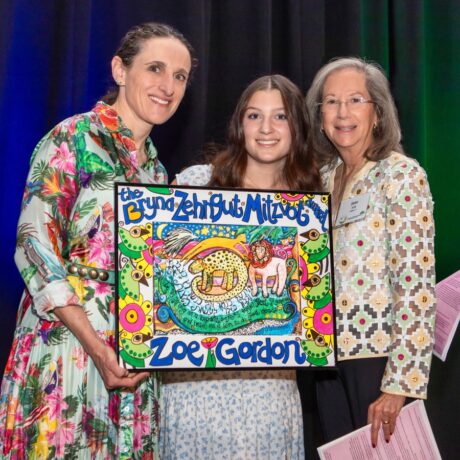
This year, the Zehngut committee gave out two awards, to Zoe Gordon and Hannah Levin.
Zoe, a senior at Tanque Verde High School and member of Congregation Anshei Israel, “has dedicated countless hours to her community as a religious school teacher’s assistant, Bar Mitzvah tutor, Torah reader, youth choir participant, and active member of USY,” said Mitzvot Award co-chair Jane Ash, adding that “beyond her involvement in our Jewish community, Zoe demonstrates remarkable civic responsibility through extensive volunteer work through National Honor Society and HOSA Future Health Professionals.”
Hannah “has demonstrated her commitment to Jewish learning and community, serving as a teacher’s assistant at Kol Ami, participating in confirmation, and helping strengthen Jewish student life at Catalina Foothills.” Hannah’s civic responsibility “and passion for social justice” are evident in “her roles as an attorney with the Pima County Teen Court, vice president of the Youth Health Action Team, and member of the Jewish Latino Teen Coalition,” said Mitzvot Award co-chair Sarah Singer.
Nominations for the 2027 Bryna Zehngut Mitzvot Award are now open. For more information, contact JPSA Impact and Engagement Coordinator Alissa Noel at [email protected].