
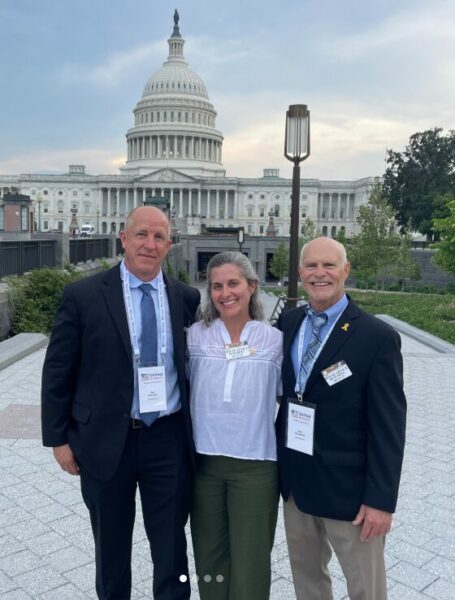
Carina Bien-Willner, Jewish Philanthropies of Southern Arizona director for public affairs at the Center for Jewish Resilience; Paul Patterson, JPSA deputy community security director; and Kent Blumenthal, a member of the CJR steering committee, joined almost 400 Jewish leaders in Washington, D.C., last month to lobby lawmakers for increased funding for Jewish community security.
Jewish Federations of North America and the Conference of Presidents of Major Jewish Organizations convened the United for Security Emergency Leadership Mission, held June 25-26.
A six-point security agenda supported by Jewish organizations across denominational and political spectrums starts with increasing funds for the Nonprofit Security Grant Program to $1 billion.
“Amid a tidal wave of antisemitism in our community — anti-Jewish hate that starts with rhetoric and results in the horrific violence we witnessed in the recent attacks in D.C. and Boulder, Colorado — these nonprofit security grants have never been more important,” Bien-Willner says.
“People often do not realize that while Jews make up only about 2% of the U.S. population, we are the target of over 60% of all religiously motivated hate crimes,” she says.
Bien-Willner explains that the grants help nonprofits such as synagogues, Jewish day schools, and Jewish community centers improve physical safety by adding features such as security cameras, gates, and physical barriers.
“For the last few years, less than half of the applicants received funding,” she says.
Without these federal funds, nonprofits must pay out of pocket for urgent security upgrades. This cuts into funding for the important services these organizations provide, including education, mental health. and elderly support, she says.
In Washington, the Southern Arizona delegation met with Sen. Mark Kelly and Rep. Juan Ciscomani.
“Paul was an amazing advocate,” says Bien-Willner. “I am so glad he was there because he was able to speak to the needs we have and the very real deficiency in resources, because they have been cut from the different law enforcement agencies. It was very eye-opening for the legislators to understand this and how it is all interrelated.
“Congressman Ciscomani spent over an hour listening to our concerns,” she says. “He was especially interested in the types of antisemitic incidents we have faced locally in Southern Arizona K-12 schools.”
She notes that this past year, NSGP funding was reduced from roughly $500 million to $300 million.
“Congressman Ciscomani helped us secure an additional $30 million. We thanked him for his work on this issue,” Bien-Willner says.
Blumenthal was also impressed with Ciscomani.
“His support of the Jewish community and the support of Israel’s right of self-defense and to exist among civilized nations seemed to me unwavering,” says Blumenthal, a Green Valley resident who is also the founder of Beth Shalom Temple Center’s Stand With Israel committee.
“It’s a good fight that we’re fighting and it needs to be fought,” Blumenthal says of the fly-in.
“This was a rough few weeks on the Hill, but our needs don’t pause simply because politics gets ugly. Antisemitism and the security of the Jewish community is not a political issue,” Bien-Willner says.
The six-point agenda also calls for the following:
- Providing federal support for security personnel costs that Jewish communities are forced to bear
- Expanding FBI resources to fight the domestic and global war on terror
- Providing federal assistance to local law enforcement to protect Jewish institutions
- Regulating social media hate speech and incitement of violence
- Enforcing and prosecuting existing hate crime legislation
Last month, JPSA called on community members to contact members of Congress to express their support for the six-point plan.
Blumenthal hopes Jewish groups are gearing up to advocate for the plan in the next Congressional session.
“The need doesn’t go away,” he says.