
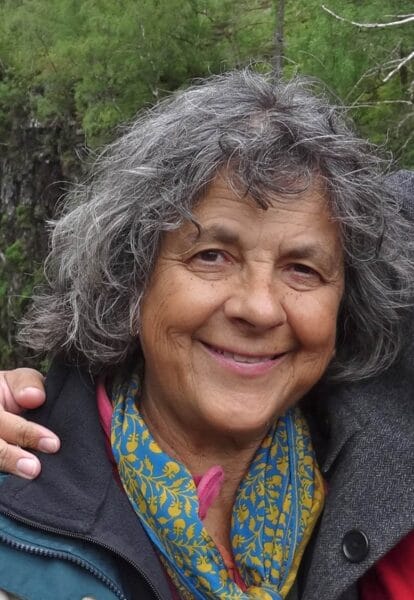
 Chris Tanz passed away at her home on Saturday, Oct. 11, 2025. Chris was a Holocaust survivor and a past board member of Tucson Jewish Museum & Holocaust Center.
Chris Tanz was born Krystyna Maria Szwienczicka on Sept. 27, 1944, in Warsaw, Poland. Her parents, Henryk and Regina, were born in Krakow in the early 1900s.
On Sept. 1, 1939, when Hitler invaded Poland, her father went to join his army regiment only to learn upon arrival that his unit had been disbanded. He made the decision that he would immediately return home and on Sept. 4, Henryk and Regina married. Within a few months, Polish Jews were required to wear an armband with a yellow star. Jews had their gold and silver confiscated, and were ordered to register for work. Soon after, Jews like Chris’ family could no longer change their residence or even ride on trains.
Later in 1940, Chris’ parents, grandparents, and her aunts and uncles were required to move to the Krakow Ghetto. At first, it seemed like a safe haven. That quickly changed when her mother, Regina, witnessed a woman executed just outside of their apartment.
Henryk and Regina then took the first of many steps to preserve their lives. They decided to leave the ghetto with forged ID papers and even remarried under their new, assumed names. Chris’ family fled to Warsaw, where they did their best to just make a living and stay alive. There were many times when they were almost exposed and captured but they persevered. Chris explained that, “My parents were young, they were strong, and they were brave.” Tragically, all of her grandparents would be murdered in an “action” in October of 1942.
In August 1944, the Warsaw Uprising erupted, where the Polish resistance revolted against the German army. Living as a Pole with a Polish ID ceased to be protection. There were Nazi roundups and shipments of Poles. Hundreds of thousands of them were deported and killed. Warsaw was leveled. Her parents fled to Otwock across the river, where they could see the smoke rising from the destruction.
While in hiding in Otwock, Chris’ mother learned she was pregnant. Her parents would later tell Chris that right away, they began debating what to do, could they even keep this baby? Listening to the troop movements on a contraband radio, her father became convinced that “This baby will be born in freedom.” Henryk was not entirely right, but remarkably close. The war wasn’t over, but they had managed to get outside the zone of German occupation.
When her mother went into labor, her parents set out for help. They were on foot, stumbling through potato fields in the no-man’s land between German-occupied Warsaw and the Russian lines on the east side of the river outside the city. Shells were flying overhead but they met a man with a horse and buggy who agreed to give them a ride to a little hospital, a tuberculosis sanatorium in the tiny hamlet of Sródborów that had been converted into a Russian field hospital.
Chris Tanz was delivered by a Russian military doctor without incident on Sept. 27, 1944. The doctor asked the new parents if they knew what day it was. They did not. He told them it was Yom Kippur. In addition to the relief of a safe birth, there was the extraordinary sensation of having been recognized without an immediate threat implied. The doctor was a Russian Jew.
When the war ended, the new family of three made their way to Gdansk, where they would work and begin to build a new life. It was then that her brother Mark was born. Despite their efforts, safety and security continued to be an issue for Jews and their families in Poland. In 1946, there was a pogrom in Kielce. Although the war was over, the family remained in hiding, still pretending to be Catholic Poles named Szwienczicka.
Eventually, the family would leave Poland for France, settling first in Paris, and later in Enghien-les-Bains, where Henryk struggled to get a work permit. Eventually, as the Korean War intensified, the fear that the Soviet Union might invade Western Europe caused her parents to look for yet another new refuge. This time it would be in the United States. In October 1951, the family boarded a ship called Liberté and set out for New York.
Chris recalls arriving in New York at the age of seven and looking through a porthole at the grey November sky and sea and seeing the Statue of Liberty. The family would settle in Chicago and begin the process of reclaiming their Jewish identity, including having her brother circumcised at the age of four years old.
After being accepted into the prestigious Lab School for high school, Chris would follow that extraordinary educational experience with an acceptance to Harvard Radcliffe for college. It was a freshman seminar with German American psychoanalyst and professor Erik Erikson, who invented the concept of “identity crisis,” that led to her eventual choice of a career in the field of developmental psychology.
Later, Chris would go on to get her Ph.D. in psychology, specializing in “developmental psycholinguistics.” This interest she attributed to her own meandering childhood that had taken her through the languages of Polish, French, and eventually English.
In 1975, it was this field that brought her to Tucson with a job as an assistant professor in the psychology department of the University of Arizona. In addition to teaching, Chris focused on research and writing, publishing her first book, a children’s book named “An Egg to Sit On,” in 1978. Later, in 1980, she would author a much more academic tome titled “Studies in the Acquisition of Deictic Terms,” published by Cambridge University Press.
Tucson is also where Chris would meet and marry Jean-Paul Bierny in 1979. Like Chris, Jean-Paul, a doctor of radiology, brought memories of the war from his childhood in Belgium, including Nazi occupation.
In 1983, they welcomed a son, Philippe, who they raised multi-lingual in their Southwestern home. Philippe would study and learn to speak French, Spanish, and Chinese, which he would put into practice often as a family medicine doctor. As Chris explained, “So, this Belgian-Polish couple meets in Tucson and produces a native Tucsonan who becomes a citizen of the world.”
Chris, too, was a woman of many talents and interests. In 1983, she left her position at the University of Arizona and began looking for her next calling. She was fascinated by public art and decided to try to become an artist and creator. Led by her parents’ example in starting new lives and encouraged by her husband’s enthusiastic support, Chris reinvented herself.
Partnering with an architect friend, they built their first project together and their careers in public art were launched after winning a public art competition. Chris described her projects as “site-specific monuments in public spaces; works that tell stories about the landscape and the community, the people who once lived here and the people who live here now, the creatures, real and imaginary, the rocks, the light.” She called these works “celebrations of place for my community.”
Today, you can see Chris’ installations in many places around Tucson and Southern Arizona. A few of these include “Strata: Gateway to the Catalinas” along Catalina Highway, “A Gnesis Bench to Sit On” at the Rio Vista Natural Resource Park, “Joining Hands” near the Julian Wash Greenway of the Loop, and “Sun Circle” at the Rillito River Park. You can see photos of her work here.
Later, Chris would be active with other local Holocaust survivors through their weekly meetings at Jewish Family & Children’s Services and as a board member at Tucson Jewish Museum & Holocaust Center up until 2024. Through it all, she was a friend to everyone she met. She would engage even strangers in deep conversations about themselves and in turn share her own wonderful stories.
This in memoriam is just a small portion of Chris’ remarkable life story. Much of this remembrance was drawn from Chris’ story as she shared in “Hiding in the Open,” a chapter in “Born into a World at War” (an excerpt of which you can find on Jewish Family & Children’s Services website here) and pulled from the testimony that she gave to Laura Markowitz in the production of AZPM’s Children of the Holocaust, which you can watch here.