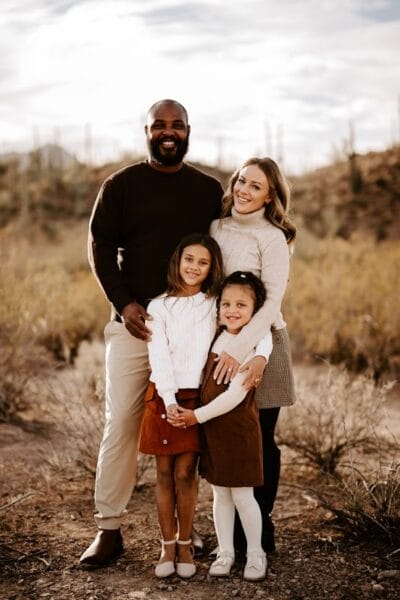
Over the past two years, Kameron Norwood, 36, has woven himself into the fabric of Tucson’s Jewish community. He’s in his second year of Jewish Philanthropies of Southern Arizona’s two-year Young Men’s Group leadership program, and he and his wife, Sara Cash Norwood, have hosted several YMG and JPSA events at their home. Norwood co-chaired JPSA’s 2024 and 2025 Super Sunday phone-a-thons and the 2025 Hava Tequila Young Leadership party, and he recently stepped into a trustee role on the JPSA board. He’s also a new member, along with two other Tucsonans, of the Jewish Federations of North America National Young Leadership Cabinet, which includes a five-year leadership development program.
“I pretty much say yes to everything that I’m asked, for the Jewish community,” he says.
With all that volunteer activity, it would be natural to assume that Norwood is Jewish himself. He’s not, at least not formally. His parents and stepparents are not Jewish and he was raised in a home where the December holiday was Christmas, not Hanukkah.
But he definitely considers himself part of the Jewish community. He grew up from the age of 10 in Tucson’s Foothills, where many of his friends were Jewish. He’s married to a Jewish woman he met in middle school and dated off and on — mostly on — since the first day of high school. They are raising two Jewish daughters. His wife considers him the most Jewish member of the family.
“I am taking upon myself to establish whatever it is that our Jewish identity is for our family,” he says.
And especially since the Oct. 7, 2023 attack in Israel, he has dedicated himself to supporting the Jewish community.
“I felt like people were attacking my family, my friends, and my community that had embraced me and wrapped their arms around me. I had this urge to get more involved, a deeper involvement in the Jewish community,” he told more than 300 of his peers at the JFNA National Young Leadership Cabinet conference in Denver this August.
The Oct. 7 attack was “a punch in the gut” for its impact on Jewish people and on young people, Norwood says, with so much of the attack taking place at the Nova music festival.
Many of his contemporaries, he says, “never thought they’d see anything like this. Never thought that the world was at this point.”
Older generations, who are closer to the events of the Holocaust, might not have agreed, Norwood says, but he thought that regarding antisemitism, the world had made progress since the end of World War II. And then Oct. 7 happened.
Before Oct. 7, Norwood says, racism against various minorities “all kind of ebbed and flowed” fairly evenly. And despite being one of the few Black kids in his school district growing up — his screen name in high school was “OneofFiveatFoothills” — he never let racism or cultural differences hold him back.
“I try to find common ground with everyone,” he says. When he and his brother-in-law had a hemp company, they met with tobacco farmers in Kentucky, men with guns in their trucks and Confederate flags on their mailboxes.
“The more I seem like I’m unfazed — whether I’m not or I am — by whatever they are and who they are and their background and how they got to this point, I feel like it’s the best way forward, to make progress,” he says.
But seeing the rise in antisemitism after Oct. 7 sparked his protective instincts.
“I just felt like the antennas were going up internally. I felt like I wanted to be involved in any way I could to help change that,” he says.
Jordan Levy, who is also in his second year of the Young Men’s Group, moved from New York to Tucson with his wife, Andrea, in the early part of the COVID-19 pandemic. Meeting Norwood and his brother-in-law, David DiCosola, and their wives, Sara and Jada Cash, at a Startup Tucson event helped the Levys plug into the local Jewish community, which they’ve found to be “juicy with opportunity and great people across all the generations, but especially the young professionals and young families,” he says.
There’s a casualness here that’s markedly different from the Jewish community he knew in his former hometown in some of the best ways, Levy says. He thinks this approachability helped Norwood establish himself as a young leader in the Jewish community.
The Levy and Norwood families have shared Passover seders and a dozen or so Shabbat dinners.
“People ask me if I’m going to convert,” Norwood says. “Convert from what? I’m not anything. I believe in a higher power … I don’t go to synagogue regularly except for holidays, I don’t currently go to church but did growing up. I appreciate the Jewish religion and culture and believe it’s important for my family to embrace Jewish values.
“My version of being Jewish is raising my kids Jewish, marrying a Jewish woman, being involved in my Jewish community, helping out any way I can, being a mensch, and helping to build that community for the next generation.”
“I have rabbi friends who tell me, ‘That’s great. You’re here, we need you; we love this,’” Norwood says.
Nate Weisband, JPSA Young Leadership Manager, couldn’t agree more.
“Kam is a bright light for our Jewish community, and we’re so lucky to have him! He brings incredible energy and enthusiasm to everything he takes on, especially his involvement with Young Men’s Group,” Weisband says. “As a natural leader and philanthropist, it’s been inspiring to watch his growth as he takes on new responsibilities and deepens his engagement both locally and nationally as a first-year member of the National Young Leadership Cabinet. I’m excited to see all the great things he’ll continue to contribute to Jewish life.”