
“One of our main goals is to always make sure that nobody’s afraid to be Jewish,” Paul Patterson, Jewish Philanthropies of Southern Arizona deputy community security director, told the audience at a JPSA security briefing, “Situational Awareness: See Something, Say Something,” on July 17.
“Our security initiatives do everything in the world we can to make this the safest place possible,” he said.
Patterson emphasized the importance of exercising situational awareness — “keeping your mind in the here and now” — at all times, but especially when attending large events such as the upcoming JCC Maccabi Games® and High Holiday services.
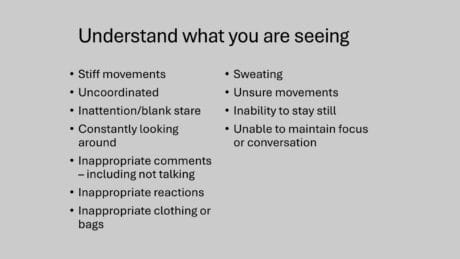
He detailed cues that can help identify “an unsavory character,” including stiff movements or an inability to keep still, a blank stare or constantly looking around, and being inappropriately dressed for the occasion, such as wearing a bulky jacket outside during the summer.
With more than 1,000 Jewish teens, coaches, delegation heads, and family members coming to Tucson for the JCC Maccabi Games, Patterson and Community Security Director Chelsea Gutierrez, both former police officers, have been working on security plans for more than two years in collaboration with local, state, and national law enforcement and intelligence agencies.
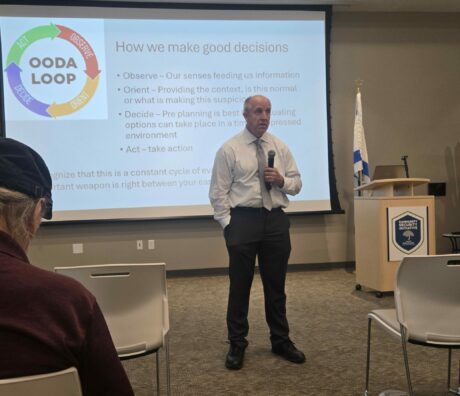
Patterson spoke about emotional and physiological reactions to stress that can not only affect the way an unsavory character behaves, but can also impede a bystander’s ability to notice important details and make critical decisions. He presented fighter pilot James Boyd’s OODA Loop, which stands for “Observe, Orient, Decide, and Act,” as a tool to help maintain situational awareness.
Addressing people’s reluctance to report a suspicious person or incident because they think it might not be important, Patterson urged people to make the report.
“What you’re seeing, or what you may see, might be a piece of a puzzle,” he said, “and if five people saw different pieces and [we] put it all together, we might recognize we have a bigger problem.”
“We love nothing more for you to call us up” to report an incident that turns out to be “absolutely nothing,” he added. “We’ll be very happy to do all the investigative side of it and reach back and say, ‘Yeah, we looked into it and it’s not a big problem.’ That is much better than not hearing about it and finding out it was a small piece that grew into a much bigger problem.”
Incidents can be reported on the JPSA website here or by calling (520) 577-9393. Reports are forwarded to the security directors’ cell phones.
In a situation that might pose an immediate threat, always call 911 first, Patterson reminded attendees.
“If you ever wondered, should I call 911 or should I not call 911, what is the answer? Absolutely, no matter what the question, if you’re thinking, I don’t know, the answer is ‘Yes, you should,’” he affirmed.
Patterson also shared commonsense emergency preparedness tips, including keeping cash in your wallet and/or car in case automated payment systems go down, and having a written record of phone numbers for key family or friends, in case your cell phone is lost or broken.
Rising Antisemitism and the Need for Heightened Security
Giving context to the security director’s tips, Carina Bien-Willner, Director of Public Affairs at JPSA’s Center for Jewish Resilience, shared national data on the rise in antisemitism.
“Many people do not realize that Jews are 2.4% of the U.S. population, yet we are the target of over 66% of all religiously motivated hate crimes in America,” she said, citing figures from the Anti-Defamation League.
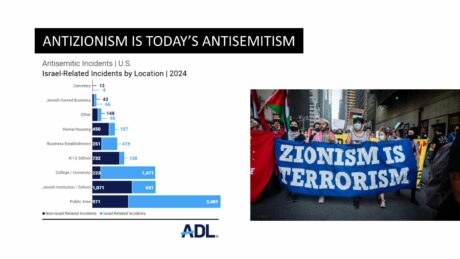
Antisemitic incidents have increased almost 900% in the last decade, she noted, adding that the majority of incidents in 2024 were related to Israel.
While those are nationwide numbers, the CJR has fielded many reports of antisemitic incidents in Tucson and across Southern Arizona this year, from bullying in schools to workplace harassment to vandalism, Bien-Willner said, adding “The majority of our local incidents also involve Israel.”
When incidents are reported, she said, “We can advocate for the affected students. We can advocate for the Jewish community. We can advocate for change.”
The CJR has been successful in educating local school administrators, principals, and teachers on contemporary forms of antisemitism including anti-Zionism, as well as giving important context regarding the topic of Jewish peoplehood.
The first step for community members is to understand what antisemitism is, Bien-Willner said, adding that she can provide educational resources.
Next, she said, if it feels safe to do so, people should stand up for themselves or their friends; otherwise, the person making anti-Jewish comments “thinks it’s OK to continue saying the things that they’re saying.”
A handout available at the briefing detailed action steps for anyone experiencing antisemitism in school.
“What can you do proactively?” Bien-Willner asked, answering, “You can talk to your school or your workplace leadership. Make sure that Jewish voices are included, make sure that there is antisemitism education and training in your place of work or in the schools that your children or grandchildren go to. Get involved locally. Join the school board, join the JCRC and the Public Affairs and Antisemitism subcommittees.”
Bien-Willner concluded with advice she admitted was borrowed from Robin Friedman of TribeTalk, who gave a workshop in Tucson earlier this year: “Just be Jewish … the most important thing you can do is find the thing that is meaningful to you and your family about being Jewish.”
Not a drill
Minutes before the July 17 meeting, a minor, single-car accident took place outside JPSA.
Gutierrez swung into action, confirming no one was hurt and interviewing the driver and passengers while waiting for Tucson Police Department officers to arrive and make a report.
Some attendees arriving at JPSA wondered if the incident had been staged as a test of JPSA’s security apparatus. It had not, but it helped underscore the need for situational awareness at all times.