
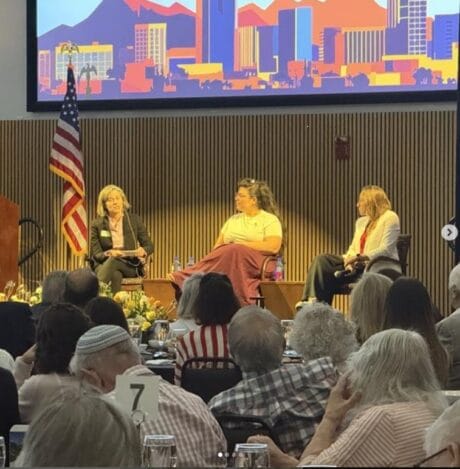
For many weeks after Oct. 7, Israeli singer-songwriter Linor Ein Gedy could find no comfort in music.
“Music has always been my source of strength, of solace, and my way to channel my emotions. It wasn’t only my livelihood. It was my way to turn pain into beauty, and I was scared that I lost that,” she told 300 community members gathered for Jewish Philanthropies of Southern Arizona’s inaugural Southwest Institute dinner on Oct. 26.
Ein Gedy was one of two main speakers for the evening, joining scholar Dr. Rachel Fish, who also led the institute’s daytime program on contemporary antisemitism in education.
Ein Gedy began her presentation with a song popularized by Brazilian singer Mercedes Sosa, “Gracias a la Vida,” or “Thanks to Life.” She grew up hearing the song — her father is Brazilian — but it has new meaning for her since Oct. 7.
Ein Gedy told the audience how she survived the attacks two years ago. The attackers had cut the electricity at her community, Kibbutz Mefalsim, on the Gaza border, and she hid in her tiny, dark, stuffy safe room for hours, her only weapon a pair of nail scissors. Occasional WhatsApp messages on her phone provided scraps of information about what was happening.
Kibbutz Mefalsim was lucky, she said. It could easily have shared the fate of nearby Kibbutz Kfar Aza and others that had heavy casualties, but the volunteer security squad managed to repel the attackers, later joined by members of the Shin Bet security service and Yamam, a SWAT-like counter-terrorism force.
While no one within the kibbutz boundaries was kidnapped or murdered on Oct. 7, the kibbutz lost eight members in fighting elsewhere, Ein Gedy said, detailing her relationships with several of them.
When she was finally able to pick up her guitar, she said, she wrote a song called “Aneinu,” which means “Answer us.”
“It was a prayer that despite everything, our people will come back and we could rebuild,” she said.
Ein Gedy also spoke of finding deep connections with Jews in the U.S. since Oct. 7.
“Our lives are intertwined, and it has been like that forever, no matter how far we lived,” she said.
Through her songs and stories of sorrow and hope, Ein Gedy touched people’s hearts.
Fish was no less impassioned outlining the historical context of antisemitism, or Jew-hatred, in America, including the influence of foreign governments and foreign money on higher education.
“What happens on campus never stays on campus,” said Fish, whose career as a scholar and activist includes co-founding Boundless Israel and previously serving as executive director of the Foundation to Combat Antisemitism. She also served as senior advisor and resident scholar at the Paul E. Singer Foundation in New York City and executive director of the Schusterman Center for Israel Studies at Brandeis University.
For 20 years, she said, she has been warning that antisemitic ideas will leave the ivory towers and impact social justice movements, politics, and media, both traditional and social.
In politics, Israel, which once had bipartisan support, is now a wedge issue for what she calls the “hard left” and “hard right,” she said, noting that both sides are edging closer to the center. “We are in many ways, politically homeless now.”
Even within Jewish communal institutions, she said, we have educators “who are afraid to touch the subject of Israel. They are afraid to engage in teaching youth, let alone young adults, about Israel, because, primarily, they do not believe that they can create an environment that allows for civil discourse around the subject of the Jewish state.”
Along with denouncing Jew-hatred, the answer lies in promoting Jewish and Israel literacy and a deeply connected community, she said, provoking applause when she stated that “our identity is much deeper, thicker and much more substantive than any antisemite will ever define our identity to be.”
“We need a Judaism and a Jewishness that is not predicated on victimhood. Vulnerability is acceptable, but we cannot think that our identity will be sticky and substantive enough if it is just about persecution,” Fish said.
While it is impossible to eradicate antisemitism, she said, we need to make Jew-hatred socially unacceptable in the 21st century, “the way it is socially unacceptable and needs to be socially unacceptable when other communities are targeted.”
During the question-and-answer period that followed both women’s presentations, Fish spoke about growing up in a small town in Tennessee with very few Jewish families.
In middle school, another student etched a swastika on her locker. The principal was ready to expel him, but Fish had a different plan. Recognizing that being expelled would be a win for this boy who hated school and had been held back, she offered to sit with him every day and read “The Diary of Anne Frank.”
“This is not some after-school special where this student and I became best friends,” she said. They didn’t, but he never did anything antisemitic again, to her or her little brother. He would say hello when he saw her in the hall, and he graduated with her class.
“If we think every time the answer is we’ve got to have a public shame campaign, it’s the wrong answer,” she said, crediting her parents with making it clear that she and her brother had to take responsibility “for who we are and what we want this world to be.”
Asked how Israelis have moved forward since Oct. 7, Ein Gedy said that most, including her, are still in survival mode, living with untreated PTSD, although growing up with the ever-present possibility of danger has made them resilient.
She reiterated that coming to America has given her a sense of American Jews as her brothers and sisters. “I know it’s a cliche, but we’re stronger together,” she said.
“It was an outstanding evening,” JPSA volunteer Karen Faitelson commented via a post-event text. “The subject matter was intelligently and sensitively handled, and the audience was extremely receptive. The room was filled with warmth, sadness, compassion, camaraderie, and hope. I personally felt a tremendous sense of pride at being a part of this wonderful community.”
The Southwest Institute was presented by JPSA’s Center for Jewish Resilience in partnership with Brandeis University, Boundless, and the Arizona Center for Judaic Studies at the University of Arizona.