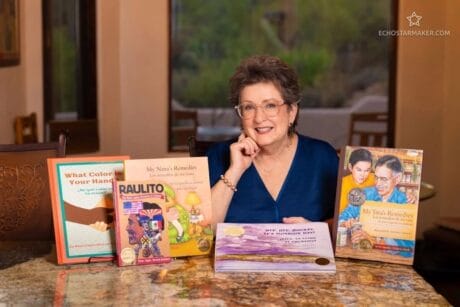
Tucson resident and author Roni Capin Rivera-Ashford originally wrote “What Color is Your Hand?/ De qué color es tu mano?” 24 years ago, after a poignant moment with her 4-year-old grandson, Jordan.
She and her husband, Daniel, had taken Jordan to Legoland in California on vacation. When Rivera-Ashford was helping her grandson in the restroom and as he was holding onto her hand, he suddenly said, “Nani, my hand is not the color of your hand, and your hand is not the color of my hand.” Her grandson’s mother was a refugee from Angola, Africa, so his skin is darker than hers.
“He was in a state of distress, so I came up with this little story to acknowledge the difference and to add some beauty, some deliciousness,” she said as she compared their skin colors to coffee and cream and chocolate and milk.
“It was quite an experience for us,” she said. “That’s how my writings come about, from either traumatic experiences, loss or tremendous joy.”
This is Rivera-Ashford’s first self-published work and her fifth bilingual children’s book. Her previous titles include “Raulito: The first Latino Governor of Arizona / El Primer Gobernador Latino de Arizona,” “My Nana’s Remedies / Los Remedios de mi Nana,” “My Tata’s Remedies / Los Remedios de mi Tata,” and “Hip, Hip, Hooray, it’s Monsoon Day / Ajúa, Ya llegó el Chubasco!” She also wrote several books for Disney to accompany the animated film “Coco.”
She had pitched the book to publishers in the past, but it was never accepted.
“I thought, okay, I’ve got enough name recognition out there that I think I’ll be good doing this on my own, and I decided to jump in and make the investment,” she said. “Sometimes it’s hard but I have to keep reminding myself, and maybe it is like that for many of us, that everything comes at the perfect time.”
Her books have won numerous awards, including from the International Latino Book Awards, annual awards given to authors, translators and illustrators for books written in English, Spanish or Portuguese. “What Color is Your Hand?” has been named as a finalist in several categories in this year’s awards, which will culminate in a ceremony on Oct. 25. The naming of the finalists coincided with National Hispanic American Heritage Month, running from Sept. 15 to Oct. 15.
Born into a pioneering Jewish family, she grew up in Nogales on the U.S.-Mexico border.
“My parents and my grandparents belonged to Temple Emanu-El and I made my bat mitzvah there,” she said. In 2020, Emanu-El and Congregation Or Chadash consolidated to form Kol Ami Synagogue in Tucson.
She said growing up, she experienced both Jewish and Catholic traditions because of the women from “across the border” who helped take care of her.
“They taught me how to pray the rosary, so I grew up bilingual, bi-cultural, bi-religious and today my philosophy is kindness — there is no need for temples or complicated philosophies,” she said. “My brain and my heart are my temples.”
She spoke about her approach to preserving cultural traditions, emphasizing the importance of acknowledging “the beauty and deliciousness of culture,” including food, music, art and language and “promoting the blending of all of the ingredients that we come from.”
Rivera-Ashford admitted she does things unconventionally. She doesn’t have a publicist or an agent and before becoming an author, she was a bilingual preschool and elementary teacher, as well as a translator/interpreter.
“What Color is Your Hand?” contains elements not typically found in children’s books — including QR codes that link to inspirational songs.
Rivera-Ashford said that the song “Imagine” by John Lennon was something that came “to my mind and to my heart” while working on the book, so she included lines in the story carrying that theme, such as, “Imagine what it would be like if all the birds and butterflies in the whole wide world were only one color.”
She included QR codes so readers could listen to “Imagine” in both English and Spanish in addition to codes for eight other songs, such as “Somewhere Over the Rainbow” and “What a Wonderful World.”
“The section at the back of the book is called ‘Songs for Humanity,’ and I included a quote by Victor Villaseñor on ‘walking stars,’” she said. Villaseñor is an American writer, best known for the national bestselling book “Rain of Gold,” which details his family’s spiritual and cultural roots as they journey to find a better life in America.
Another unique element in the book is a two-page dedication to the memory of Gabriel “Gabe” Zimmerman, a fellow Tucsonan who worked for Congresswoman Gabrielle Giffords.
The first congressional staff member to lose his life while at work, Zimmerman was killed on Jan. 8, 2011, during a shooting at a “Congress on Your Corner” event at a grocery store in Tucson. The shooting left six dead and wounded 13, including Giffords, who is Jewish.
In his honor, a room at the U.S. Capitol Visitors Center has been named the Gabriel Zimmerman Meeting Room to commemorate his act of selflessness and courage. The tragedy left an impact on Rivera-Ashford, and she has wanted to honor Zimmerman in her own way. She felt that adding the memorial in this book was fitting.
“It exemplifies what he stood for and who he was. He was the director of constituent services and community outreach and helped all kinds of people,” she said. “That page is just beautiful with pictures of Gabe when he was young, and his parents gave me their blessing to do this.”
Those pages also include illustrations by the artist, and Tucson native, Walter Thompson (a pen name), who worked on the entire book.
Thompson attended school with Rivera-Ashford’s oldest son Aaron, and she is also friends with Thompson’s mother-in-law, Ramona Grijalva, the late Tucson Congressman Raúl Grijalva’s wife.
She had long admired Thompson’s art and purchased T-shirts and posters from him in the past. She also shared some of her books with him for his two children.
“I wondered if he would be interested in illustrating the book, so I asked him if he’d like to read the story and let me know and he said, ‘Absolutely!’” she said. “He would send me little doodles, and it just developed from there. It was a dream working with him.”
Rivera-Ashford is already thinking about her next book, which she admitted has also been in her head for a while. She likes the title “Albondiga Today, Matzah Balls Mañana,” a play on the names of two soups from both her Mexican and Jewish heritage.
She said she makes both soups based on her Jewish grandmother’s recipes. When she was interviewing former Governor Raúl H. Castro for her book, “Raulito: The first Latino Governor of Arizona,” she would always bring him and his wife soup when visiting.
“I’d go once a month, and every time I went, I would take some kind of soup for them because they were elderly,” she said. “I asked them both once, ‘Have you ever had matzah ball soup?’ They said that although they had heard of it, they had never had it. I made them some and they really liked it.”
Rivera-Ashford said this was an important lesson in sharing traditions and the positivity that can come from learning about another’s culture.
“We need to share with each other; accepting and learning about our differences and embracing what we can,” she said. “We can’t always embrace something that is different; it doesn’t always work for us. But if we can’t embrace it, we can respect it. We don’t have to reject it.”
Reprinted from the Jewish News (Phoenix). For more information on Roni Capin Rivera-Ashford’s books, visit butterflyheartbooks.com.