
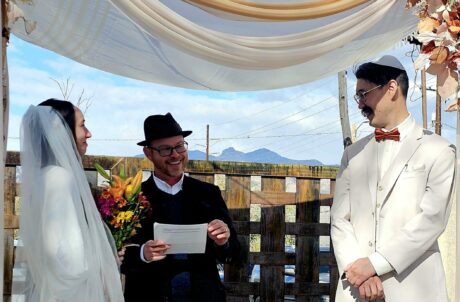
Tucson’s Congregation Bet Shalom has quadrupled in size since 2012. That’s when Avi Alpert came on board as its spiritual leader, first as a cantor and later as a full-fledged rabbi.
Congregants attribute the change to Alpert, whom they describe as “incredibly approachable” and “very open-minded, but very strong in his identity.”
On Sept. 20, Bet Shalom will honor the rabbi at a Kiddush lunch.
“When I came here, there were 59 households, mostly elderly, and they could not make a minyan on Shabbat,” Alpert recalls. Financially, the congregation was living “hand-to-mouth,” he adds.
Now the congregation offers weekday morning and afternoon prayer services. The morning services are hybrid — in-person and virtual.
The congregation now has more than 220 member households, according to Board President Anne Lowe, who also served as president from 2016-2019.
“We call them ‘Bet Shalomers,’” says Alpert, who hates the practice of defining membership by households rather than by people.
In addition to “official Bet Shalomers,” he says, the congregation has hundreds of “friends of Bet Shalom” who often contribute generously and participate in the life of the congregation.
In 2014, the congregation voted unanimously to switch from mandatory dues to a free-will giving model, which has been very successful.
“The nice part about it is it’s really tzedakah; it’s really people giving from their heart,” he says, adding that people are often more generous when they don’t feel they are just paying another bill.
A sounder financial footing has meant the congregation could also grow its staff, he notes, adding Rabbi Yosef Lopez as Rosh Beit Midrash overseeing learning for adults; Lisa Schacter Brooks as director of youth and family education; Gabby Erbst as office administrator; and Neshama Madson as administrative assistant.
Sometimes, the rabbi says, a situation can be both a challenge and a blessing, such as when the congregation offered to send him to rabbinical school.
Lowe explains that as Bet Shalom’s cantor, Alpert had been performing virtually all the functions of a rabbi, from leading services to officiating at weddings, funerals, and other lifecycle events. When a congregant died and left the congregation “a nice amount of money,” the congregation voted to send him to rabbinical school in Los Angeles.
For two years, “I was schlepping to LA” to study at the Academy for Jewish Religion, says Alpert, who received his rabbinic ordination in 2017. He would fly to LA on Sundays, returning to Tucson on Tuesday nights, Lowe recalls, adding that he was initially reluctant to accept the offer and it was his wife, Kamala, who said, “Of course you have to do it.”
“So he’s our cantor and rabbi,” Lowe says. “And what makes him so special is, he’s incredibly approachable. He doesn’t have that rabbi aura that sometimes makes people intimidated. Nobody ever feels intimidated to speak to him about anything under the sun, and we just adore him.”
Talya Simha Mizrachi enjoys the congregation’s warm and welcoming environment.
“I love how Rabbi Avi works really hard to maintain halacha (Jewish law), but just keeps such an open mind and gives space for, really, the entire spectrum of Jewish people to be able to experience something refreshing and open,” she says. “He’s very loving, very open-minded, but very strong in his identity.”
Bet Shalom has become “the young people shul in town,” she says, adding that the rabbi has supported her efforts to increase young Jewish adults’ connection to Judaism, which includes opening her home for Shabbat dinners.
Mizrachi, the rabbi explains, is one of several Jews who have moved to his neighborhood, which is walking distance to Bet Shalom.
On Friday nights, he says, she’ll sometimes call after he’s had Shabbat dinner with his family, inviting him to come schmooze with her guests. “And there would be, like, literally 80 people or more at her house that she invited … all these young people … It’s really been a thrill,” Alpert says.
People attending Bet Shalom range from those who “know they’re Jewish, but they’re not really sure what that means, and they’re unaffiliated, all the way to modern Orthodox, and even some Orthodox people,” Mizrachi says, noting that because Bet Shalom has no mechitzah (a divider between men’s and women’s sections), Orthodox attendees will simply “stand a little bit in their own space” during services.
The congregation even has non-Jewish supporters who are not in a relationship with a Jewish person, says Alpert, who also partners with non-Jewish clergy and congregations. He has become close friends with Pastor Jeff Logsdon of Hope City Church, whom he calls “a kindred spirit.”
Alpert is one of a few rabbis in town who “will literally try to collaborate and make almost anything workable, which is absolutely incredible,” Mizrachi says.
This has included ongoing Bet Shalom projects such as a chicken coop, says Lowe, who initiated that project, along with plans for new agricultural beds to grow potatoes for Hanukkah latkes and other vegetables for holiday delicacies.
The garden beds will become part of the education program for young children, she says.
Lowe, who is filling in as president for a year, says any hesitation she might have felt at taking on the responsibility again disappeared because it was Alpert who asked.
“He gives so much of his time and his whole being to his congregation. How could anyone say no to him?” she asks. “We are lucky to have Rabbi Avi as our spiritual leader who loves us as much as we love him.”
For more information about the Sept. 20 Kiddush lunch, click here.