
Fifty-plus years ago, I wrote a story on Sukkot for The Jewish News of Metropolitan New Jersey. Although I complained a great deal about the small-town nature of my Jewish immigrant community, New Bedford, Massachusetts, where I was one of only 13 Jewish girls my age, I have learned to appreciate the special qualities that infused my childhood with Yiddishkeit.
Recently, I attended a virtual celebration of Aaron Lansky, the extraordinary founder and director of the Yiddish Book Center in Amherst, Massachusetts, on his retirement. Aaron is from New Bedford, too. He is 16 years younger than I am, but most likely he experienced many of the same intense Jewish experiences that I did. While not all my peers left New Bedford with their Jewishness intact or of primary importance, many of us did.
As Sukkot approached this year, I revisited my original article. I found it still meaningful, funny, and certainly a product of my unique childhood in a small New England city with only 2,000-plus Jews out of a total of 995,000 residents. I think you will enjoy it too:
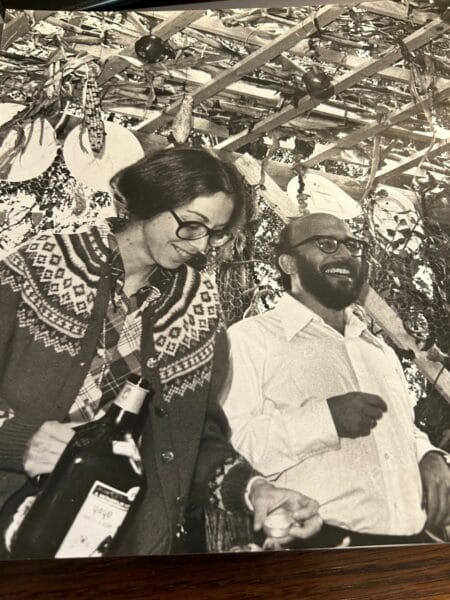
Two years ago, my husband and I were frustrated New Yorkers eagerly searching for a home in Essex County (New Jersey), drunk with the possibility of having office space of our own and a yard for our cement-bound youngsters to play in.
Every weekend, we descended on our neighborhood rent-a-car dealer to pick up the vehicle that would carry us over the George Washington Bridge and into the Garden State.
On each trip we clutched a list of house ads culled from the pages of the newspaper’s real estate section or received from gushingly enthusiastic real estate agents eager to entice us to their particular offices with a description of the perfect home.
During these months of “the search” we became quite adept at getting the children into the car before springing on them the delightful news of yet another trip “to the country.” But as time went on, we were greeted by more and more resistance from our captive passengers, a resistance neither toys nor books could assuage.
In our odyssey from house to house, we examined each residence according to an endless list of requirements. Our 6-year-old son became particularly expert in this procedure, calling our attention to the closet in the foyer, the downstairs bathroom, or the lack of a big enough yard.
One of the more important items on our list was a flat piece of ground behind the house that would be suitable for the building of a sukkah.
A glorious experience of childhood, the visit to the synagogue sukkah stands out as one of the most perfect and lovely moments of my life, the mere thought of which still creates in me incredible excitement. I can still remember the overwhelming joy with which I entered the magic world of the sukkah. It was a “secret garden” stunning to see, a pastoral fantasy appealing to sight and smell and taste.
The vision was kept fresh by its reappearance each year at the annual Sukkot celebration. But at the end of the holiday, the dream would disappear as mysteriously as it had come. One year I sneaked into the courtyard of the synagogue after the holiday season for a private peak at the modern gan eden, only to find an empty courtyard. The vision so sweet, so unreal, had vanished.
And so it became a dream of adulthood to create for myself and for my children our own pastoral vision, one which would be part of our own home to be enjoyed daily during Sukkot and not for one or two brief visits as part of our holiday observance.
One year after our initial excursion into the Garden State, we discovered what turned out to be “the” house, complete with “his and her” offices and a flat piece of land in the yard, the necessary prelude to the fulfillment of that dream.
We left New York that June and moved to New Jersey. The summer months were filled with unpacking and organizing, cleaning and painting, and the usual procession of workmen descending on the still innocent and citified folk yet to be initiated into the secrets of crab grass and leaky faucets.
And then, with the approach of fall, our attention turned to that flat piece of ground sitting invitingly behind our home. Couldn’t we wait until next fall to start on a sukkah, my husband suggested, our lives still encumbered by the presence of painters, electricians, plumbers, and carpenters?
Impossible, I thought, I just can’t wait another year.
But what to do? The phone calls began, to friends, to relatives, to everyone who night be able to shed some light on the unknown world of sukkah-building. I even sent for a pamphlet describing a prefabricated sukkah that could be erected within minutes.
After studying diagrams provided by friends from three states and many trips for advice to a professional carpenter with sketches of my own, we decided on a plan of action and courageously purchased the necessary supplies. By this time such professional-sounding words as triangles, bits and bolts were rolling off my tongue. How expert I felt!
We assembled the materials in the backyard. It was the moment of truth. My husband and I stared at each other. For three days we looked at the pile of materials we had assembled.
We were at a loss as to how to begin. Each of us was secretly angry at the other, my husband for my dragging him into the midst of leftover childhood dreams, and me for my conditioned chauvinistic response, in spite of my ardent feminism, that somehow a man is supposed to know what to do at such times.
But what we didn’t count on was the friendliness and warmth of our new neighbors, who by this time were well aware of our plight, having seen the wood and other supplies being carried into the garage.
And they came, our next-door neighbor with a better hammer and extra nails when we ran out, a carpentry hobbyist who provided us with the indispensable suggestions for getting our project off the ground, literally. And many came simply with suggestions or just plain moral support.
Then there were the neighbors who didn’t come — who didn’t come to complain or call the police as we worked at 10, 11 and 12 at night in the garage and in the yard with the noise of the electric drill and hammer echoing off the nearby houses, breaking the night’s silence.
And we did it — we built a sukkah!!!
And then the day came, and like a Pied Piper the sukkah attracted excited youngsters who poured out of their homes all around us and gathered in our yard to help us string cranberries, stringbeans and grapes, to hang apples, squash, eggplants and gourds, to help tack our New Year’s cards to the back of the sukkah and to make their own individual pictures to put up in what had become a neighborhood endeavor.
Then came the folding metal table, the wine, the cookies, and the Sunday open house with 75 Jewish and Christian friends who came to share our pleasure in the sukkah we had made.
That was last year. This year the heady satisfaction that comes from constructing anything from scratch will be gone, for the sides and roof of our sukkah have been stored during the last months in the garage.
But the excitement and the joy generated by the decorating and the use of our pastoral vision each day of the holiday of Sukkot will remain with us for years to come.
9/26/74, The Jewish News of Metropolitan New Jersey